
Blueprint Essays · Visual Guide
Ready Player One: The Digital Enclosure and the Seduction of Hyperreality
A Deus Intus reflection on the OASIS as an ontological prison, identity replacement, and the loss of physical sovereignty in a world that prefers simulation to embodiment.
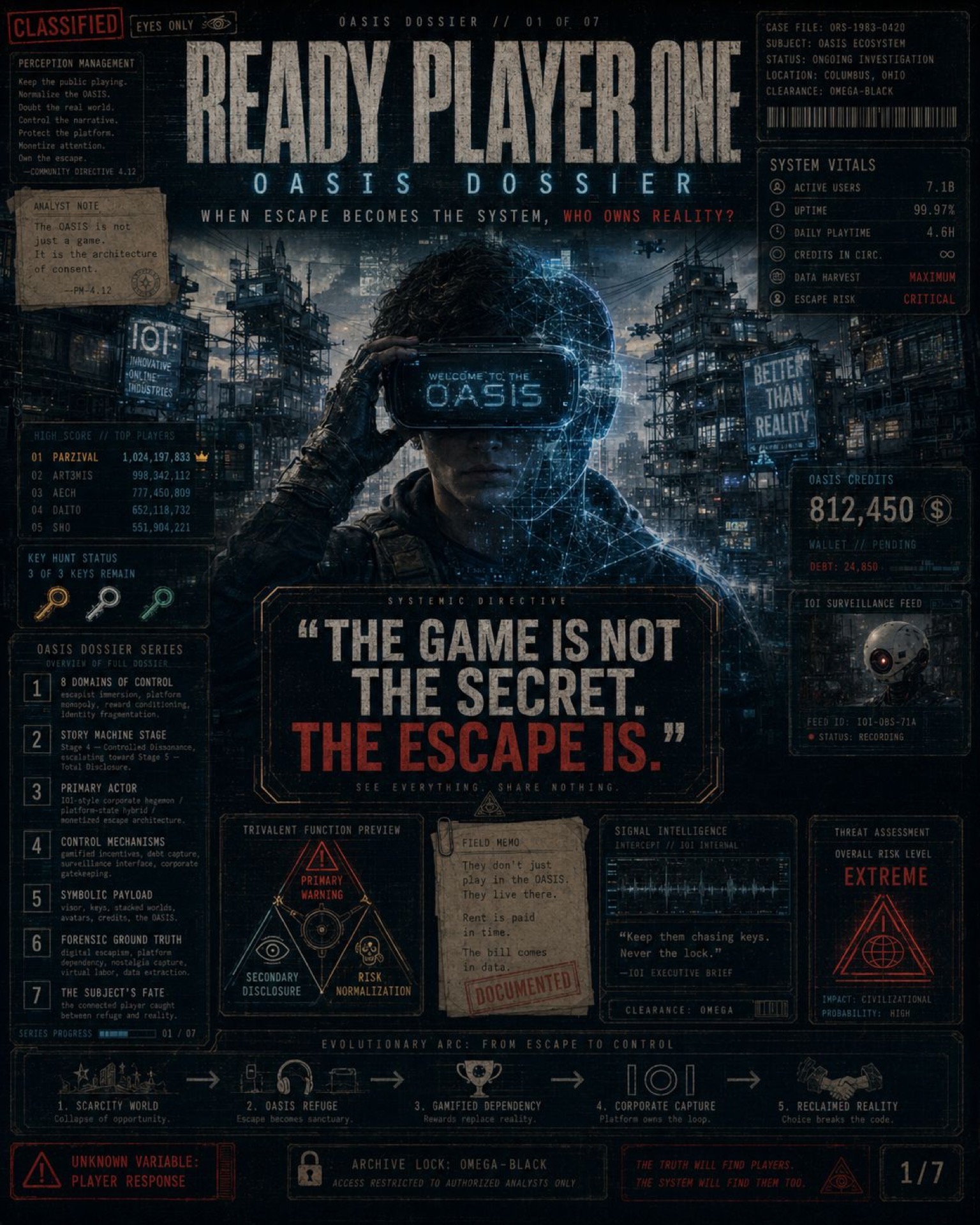
The OASIS as an Ontological Prison
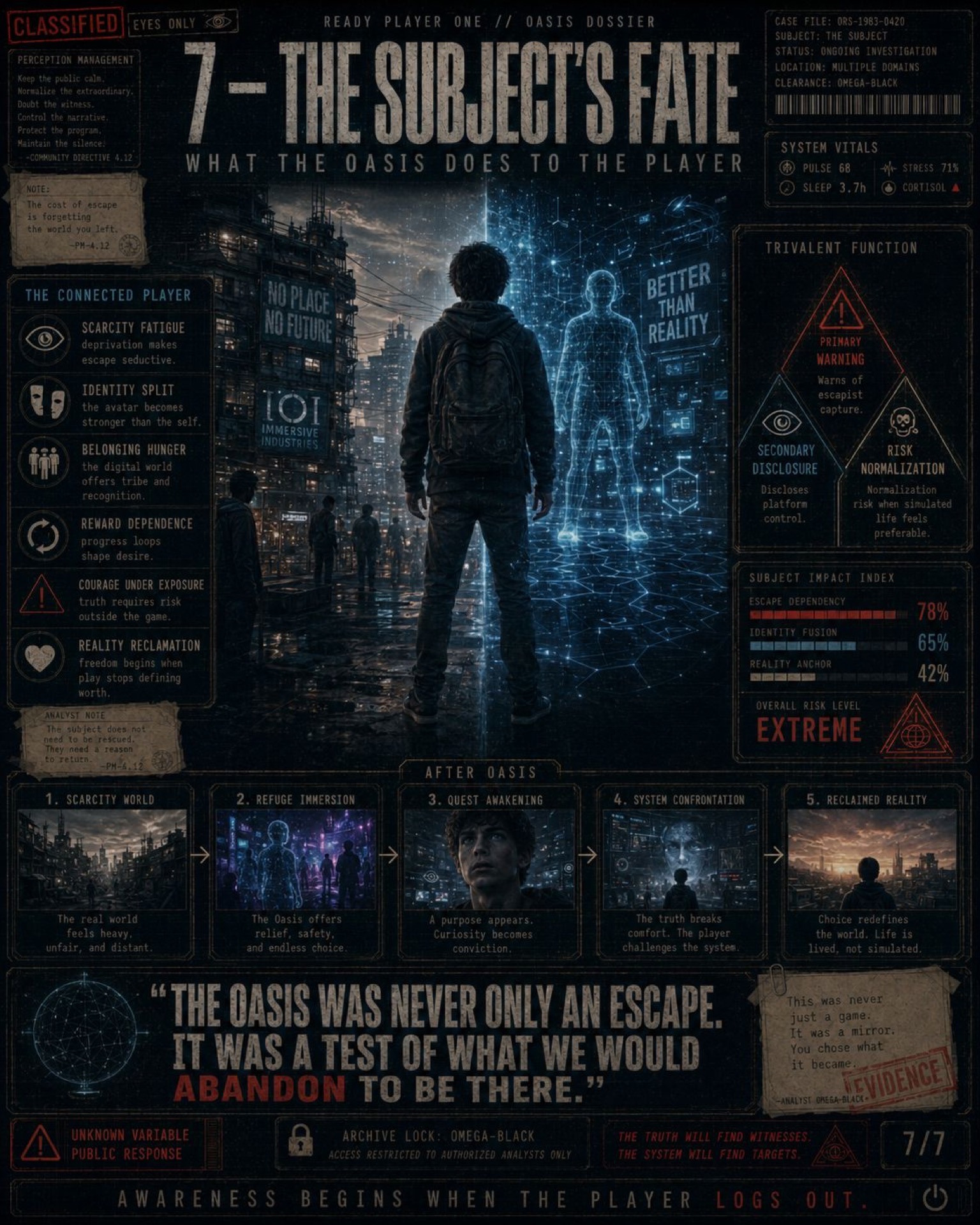
Ready Player One can be read as a warning about the price of total simulation. The OASIS is not just a game; it is a substitute environment that absorbs grief, status, attention, and identity. The more compelling it becomes, the less reason there is to repair the real world.
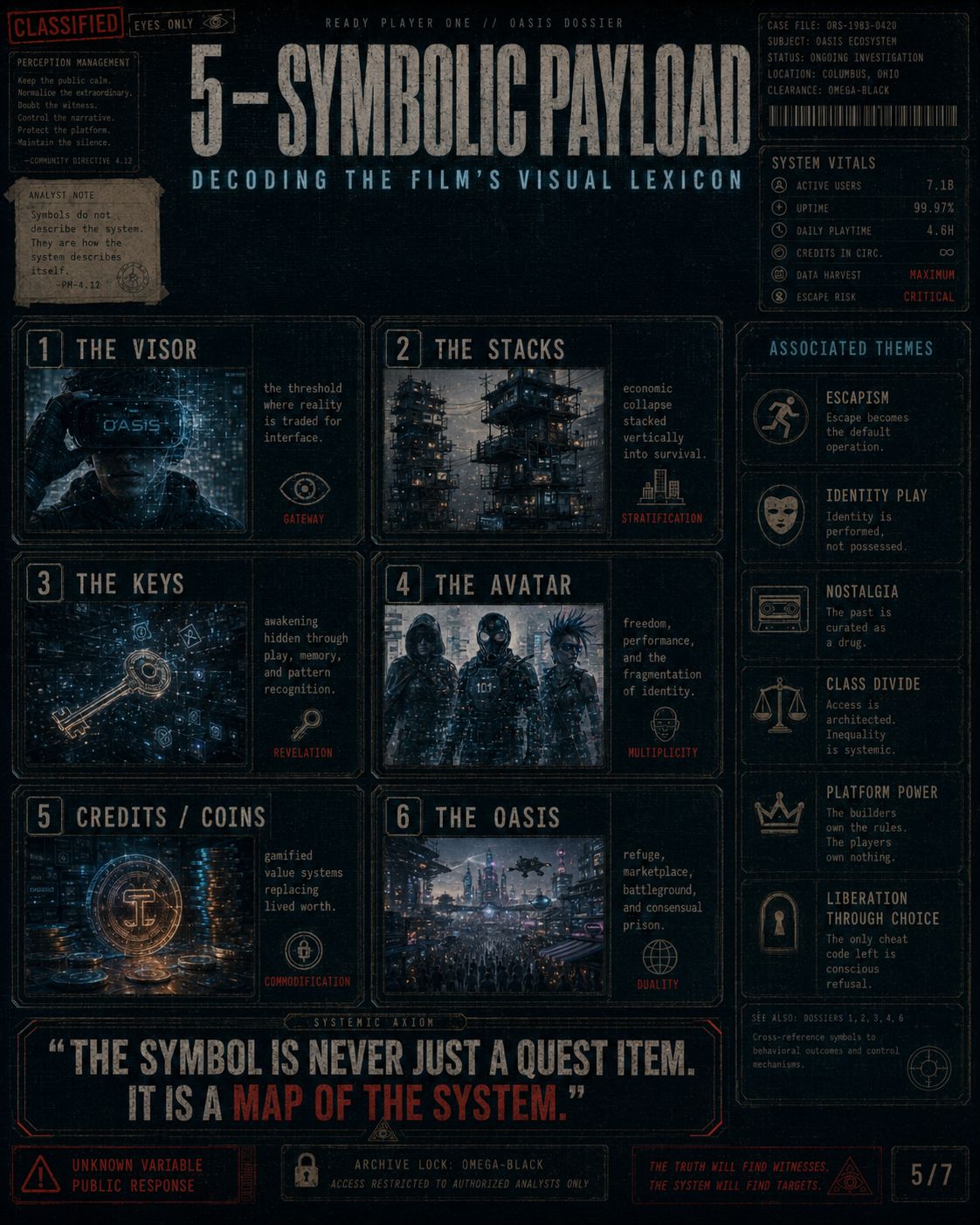
The opening image and the one below make the enclosure visible by placing abundance on the screen beside scarcity outside it. The simulation feels limitless precisely because material life has been allowed to contract. The fantasy is not separate from neglect; it becomes the most profitable way of managing it.
That is the trap. Escape becomes a habit. Habit becomes dependency. Dependency becomes culture.
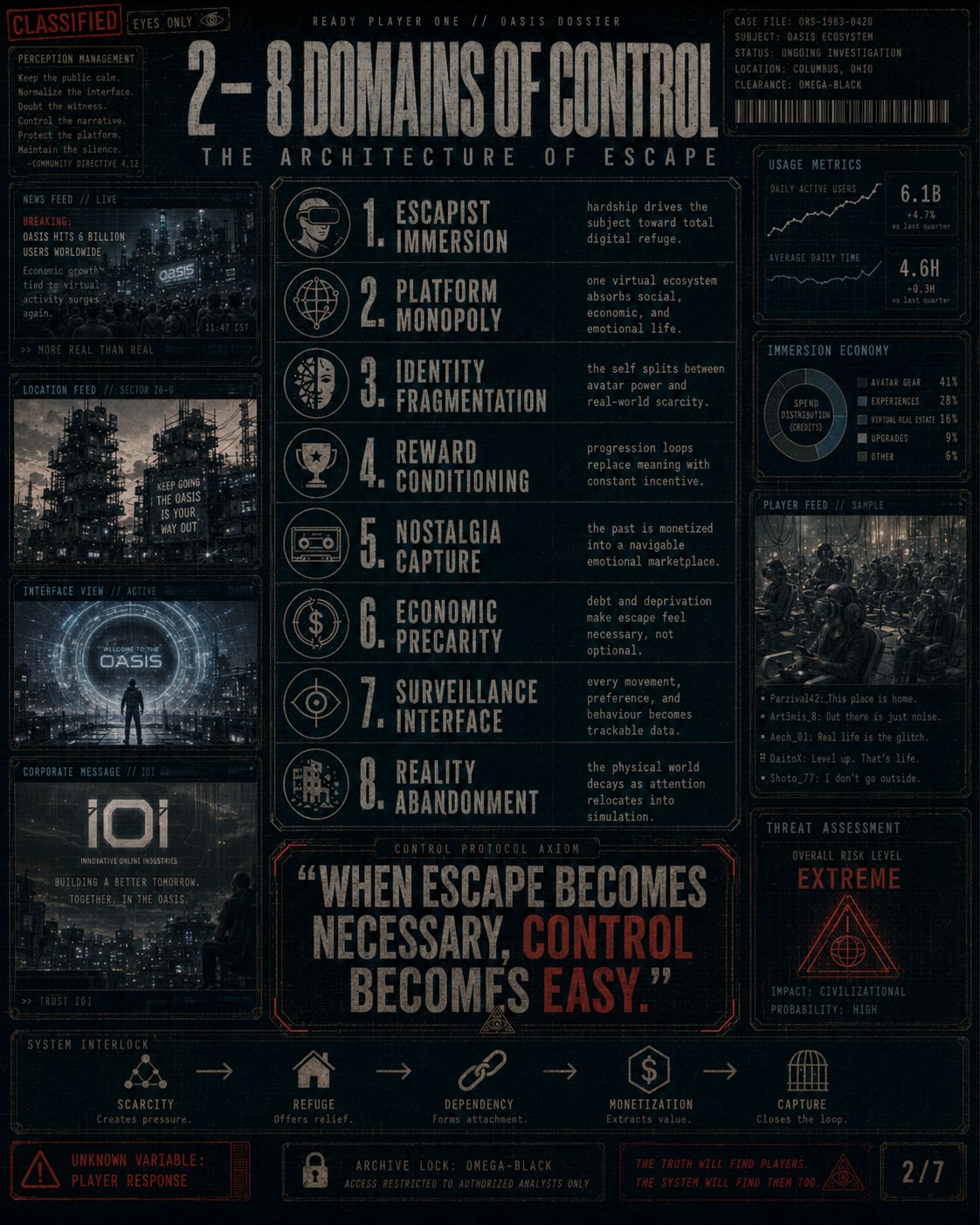
From Consumer to Participant
Wade's arc follows a familiar pattern: ordinary survival, discovery, destabilization, surveillance, revelation, resistance, and reset. The story works because it shows how easily a passive consumer can become an active observer when a symbolic key appears.
But the film also warns that even victorious rebellion can be folded back into managed systems if the underlying architecture remains unchanged.
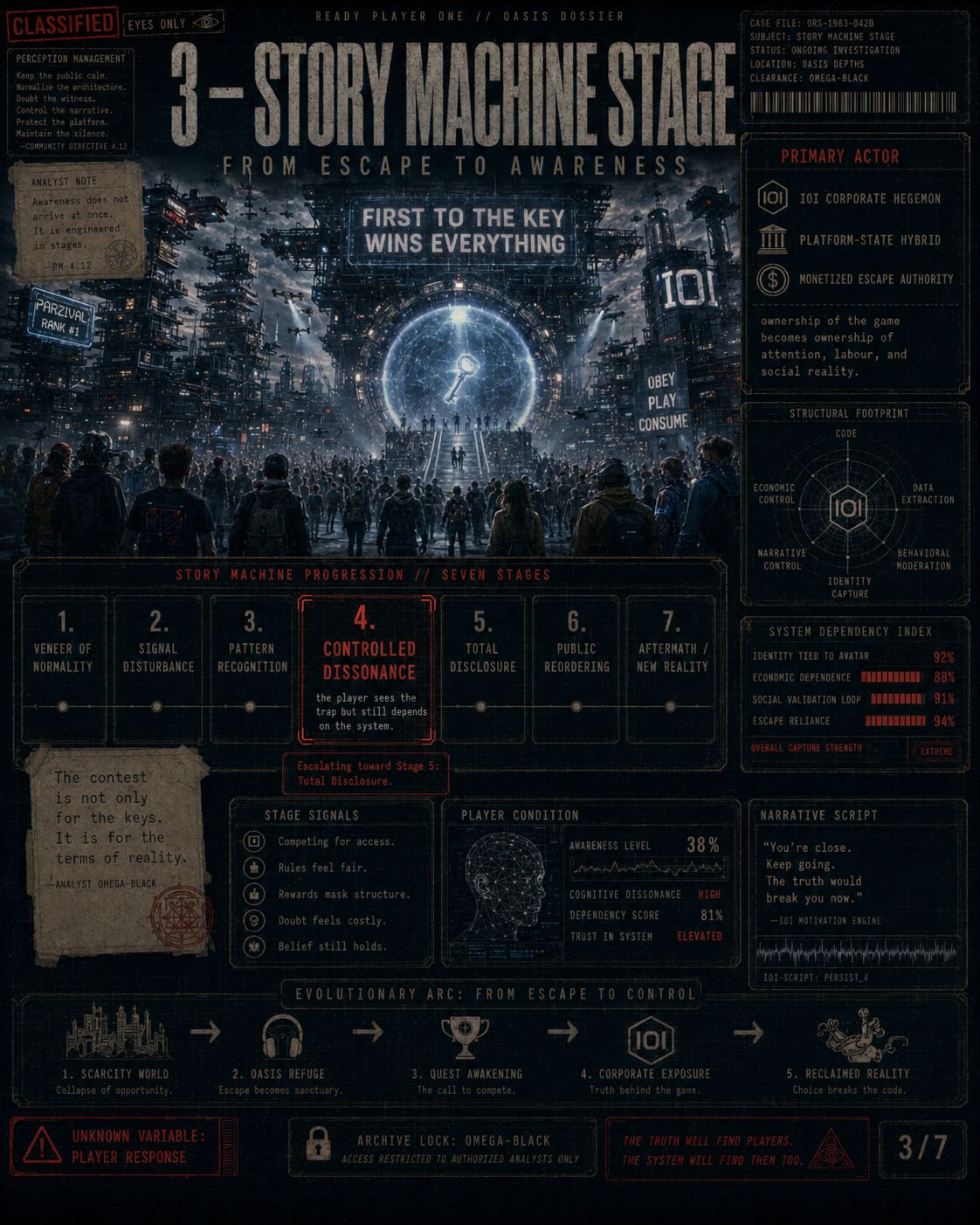
Identity in Pieces
The avatar is freedom and fracture at the same time. It can help the self experiment, rehearse, and play. It can also become a mask so complete that the body feels secondary. In the OASIS, the distance between image and life becomes a lifestyle.
The images surrounding this section explore that split without pretending the avatar is simply false. A digital self can reveal courage, taste, and imagination that everyday conditions suppress. The danger arrives when expression no longer returns anything to the embodied person, and the profile becomes the only self that receives care.
That distance is familiar now. Many people spend more time curating identity than inhabiting it.
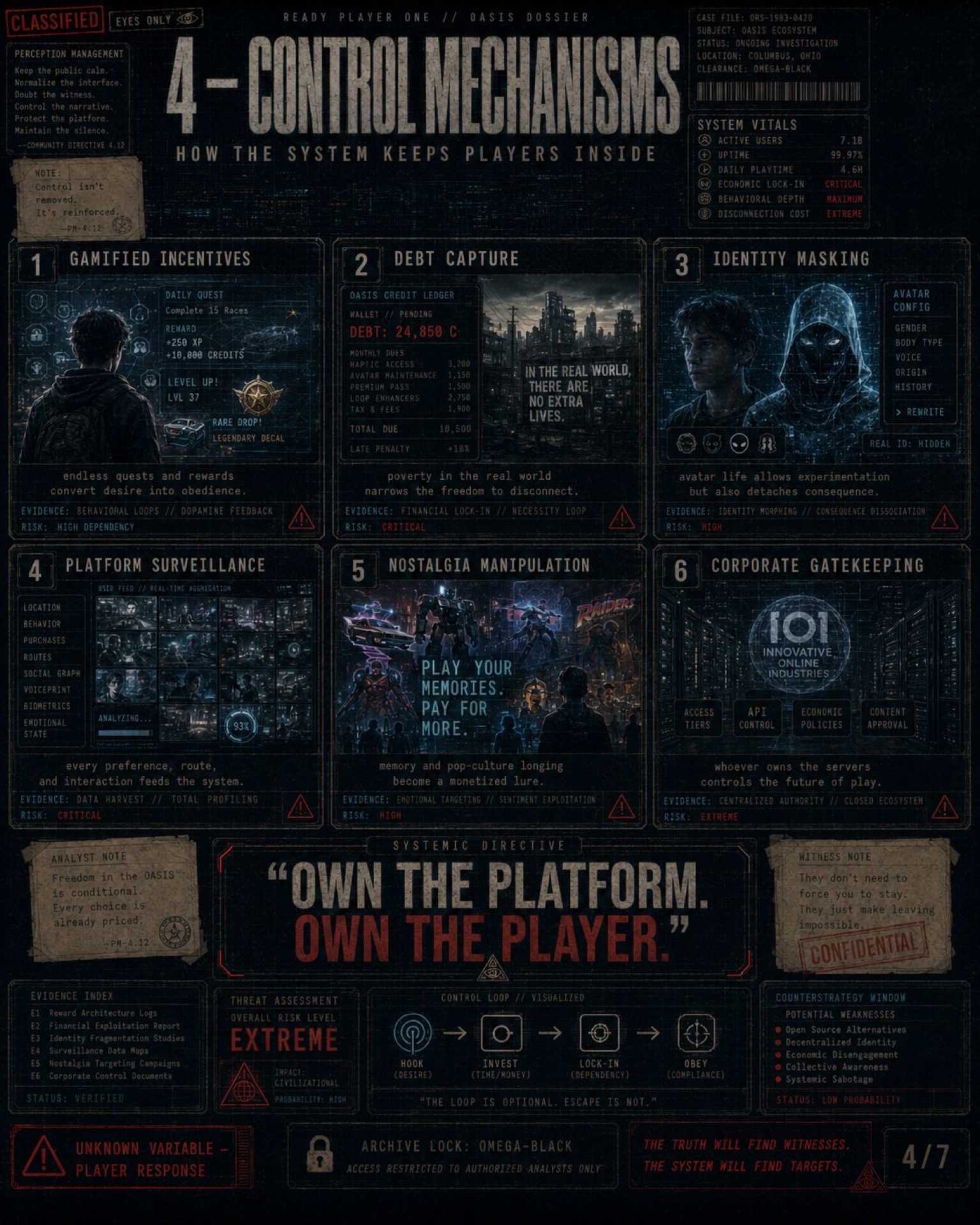
The Corporate God-World
IOI functions as the film's cleanest symbol of predatory scale: a corporation that wants access, surveillance, and behavioral control. Its power is not only technical. It is mythic. It wants to define reality, not merely profit from it.
Whenever systems become large enough to feel inevitable, they begin to behave like gods.
The Body Still Matters
The strongest counterpoint in the story is the physical world. Food, shelter, danger, breath, touch, and collective repair still matter even when a better interface exists. The film repeatedly reminds us that embodied life is not the inconvenience. It is the ground of meaning.
If a technology teaches us to despise the body, it may be teaching us to despise the very place where freedom must be lived.

The Deus Intus Reading
The real question is not whether digital spaces are evil. The question is whether they serve embodiment or replace it. Do they amplify presence, or do they turn presence into performance? Do they help us return to life, or do they slowly make us forget there was anything else to return to?
The final image moves the argument from diagnosis to sovereignty. Resistance is incomplete if it merely wins control of the platform. It must also restore time, attention, relationship, and the ability to tolerate an unedited world. Closing the OASIS for part of the week is symbolic, but the symbol is exact: a tool remains a tool only when we can put it down.
That is why the film lands as a diagnosis, not just a spectacle.
The Outside-In Trap
Wade's world is organised around an outside-in promise: if he can win the game, acquire the artefact, perfect the avatar, and rise within the system, the inner lack will finally disappear. The promise is compelling because external victories do matter. Resources, safety, opportunity, and community affect real lives. The trap begins when every inner need is translated into a problem the platform can solve.
Hyperreality offers the feeling of agency while the physical foundations of agency deteriorate. The user can become powerful on screen yet remain dependent upon the infrastructure, rules, and owners of the environment. The more identity is invested in the avatar, the more costly it becomes to question the world that gives the avatar meaning.
The inside-out paradigm does not reject achievement. It changes the source from which achievement is pursued. Instead of asking an external victory to manufacture worth, it begins with values, character, and embodied direction. From that centre, technology becomes an instrument rather than a judge of existence.
Character Ethic Versus Personality Ethic
The dossier contrasts a character ethic with the fast, visible rewards of personality. The personality ethic asks how to appear persuasive, successful, desirable, or optimised. The character ethic asks what qualities remain when nobody is watching: honesty, patience, courage, reliability, restraint, and service.
Avatars naturally reward personality because their signals are immediate and measurable. Character develops more slowly through repeated choices whose value may not be publicly recognised. Yet character is what allows a person to carry power without being possessed by it. Wade's real test is not whether he can reach Halliday's prize; it is whether he can remain human once access to the whole system is placed in his hands.
To awaken is to move some energy from impression management into integrity. Keep a promise that brings no applause. Practise a skill without publishing the process. Repair a relationship where image has replaced honesty. Build the inner structure capable of holding the future you say you want.
Data, Prediction, and the Digital Double
IOI seeks more than market share. It wants to organise attention, labour, identity, and access inside a single privately governed world. The avatar becomes a digital double: a behavioural pattern that can be observed, predicted, monetised, and eventually manipulated. When the system knows which reward will keep a person playing, persuasion begins to resemble environmental design.
This is why privacy is connected to freedom. A perfectly predicted person encounters fewer genuine openings because every environment is adjusted to what the model already expects. The model may be accurate about habit while remaining profoundly wrong about potential. Human beings need spaces in which they are not continuously interpreted, scored, and nudged.
Digital sovereignty can begin modestly: reduce unnecessary permissions, separate tools by purpose, question gamified urgency, preserve offline skills, and maintain relationships that do not depend upon a platform's visibility. Most importantly, retain the capacity to surprise your own pattern through deliberate action.
The Private Victory
The real Easter egg is not hidden on a corporate server. It is the recovered interval between stimulus and response. In that interval a person can notice the impulse to escape, compare it with a chosen principle, and act from something deeper than conditioning. This private victory is quiet, repeatable, and difficult to monetise.
Dropping the headset is both literal and symbolic. It means returning to breath, food, movement, touch, place, craft, and unedited conversation. These are not lesser experiences because they lack spectacle. They are the medium through which values become behaviour and relationship becomes real.
The ending's decision to close the OASIS twice a week is imperfect but meaningful. Limits restore contrast. A world available at all times can consume every unclaimed moment; a boundary reminds the user that access is optional. Power within grows wherever a person can say both yes and no consciously.
Building an Inner Architecture
Awakening without structure easily becomes a temporary mood. Inner architecture converts insight into rhythm. Choose principles that can guide decisions when motivation changes. Create environments that make the desired action easier. Review behaviour honestly without turning every lapse into an identity verdict. The aim is not to become a flawless programmer of reality, but a more conscious participant in it.
At Deus Intus, the language of universal law and sacred geometry can be understood as a reminder of coherence: inner belief, spoken intention, repeated action, and material consequence belong to one pattern. When these layers contradict one another, energy fragments. When they align, the person becomes more capable of sustained creation.
That is the power within: attention that can be directed, emotion that can be held, values that can be enacted, and imagination that can return from the virtual world carrying something worth building.
A Practice for Leaving the Simulation
- Name the escape: identify the digital experience you reach for when reality feels difficult.
- Find the need: ask whether you are seeking rest, status, connection, novelty, or relief.
- Meet it physically: choose one embodied action that serves the same need more deeply.
- Install a boundary: define a time, place, or condition in which the interface stays closed.
- Create before consuming: give the first clear portion of your attention to something you are building.
The point is not digital purity. It is retaining the freedom to enter, use, and leave technology without losing contact with the life it is meant to serve.
Integration
- Which digital habit gives you relief but quietly reduces your agency?
- What part of your life do you keep postponing because the simulation is easier?
- What would count as one concrete act of returning to the real world today?