
Blueprint Essays · Visual Guide
They Live: Seeing the Script Behind the Screen
A Deus Intus reflection on consumer hypnosis, hidden commands, and the discipline required to see a culture without its costume.
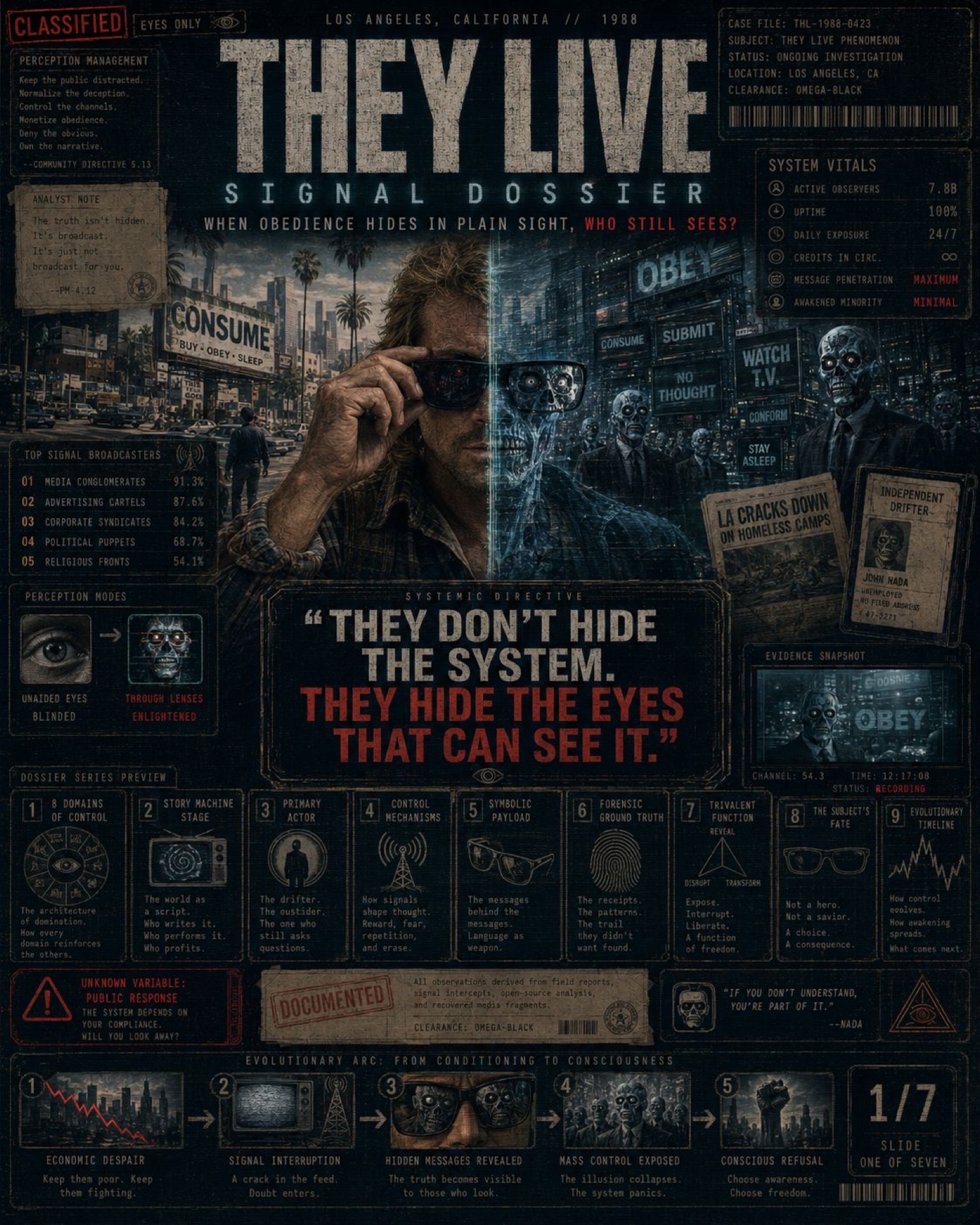
The Hidden Layer
They Live endures because it is brutally simple: there is a hidden layer under the visible world, and most people are trained not to see it. The film turns that idea into a physical act by giving the viewer a pair of lenses.
The opening image and the one below capture that threshold: the familiar city remains in place, yet its meaning changes as soon as the visual filter changes.
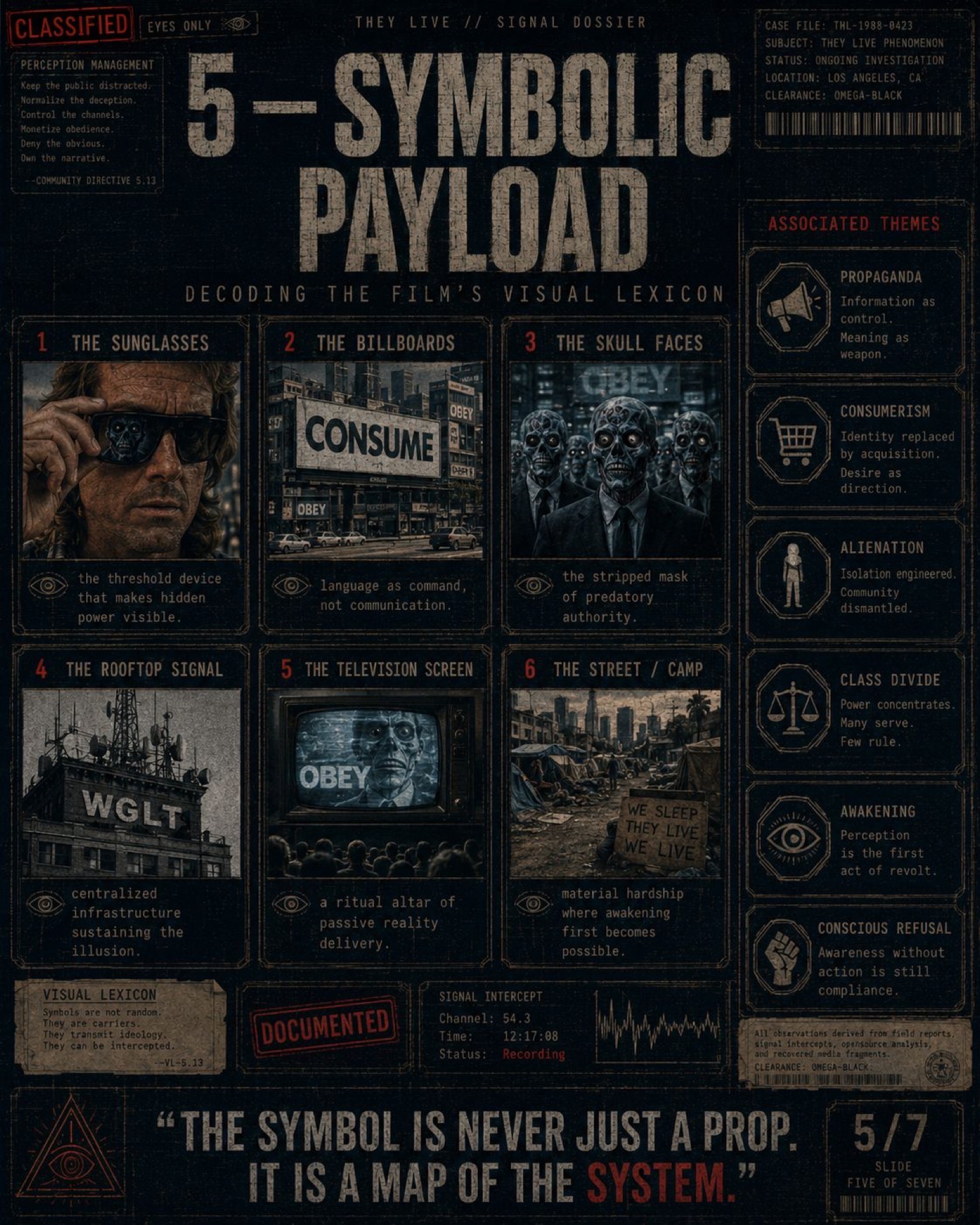
The glasses are therefore more than a prop. They represent media literacy, class consciousness, intuition, and any disciplined practice that interrupts automatic perception. Their stark monochrome vision removes seduction so the command underneath can finally be read.
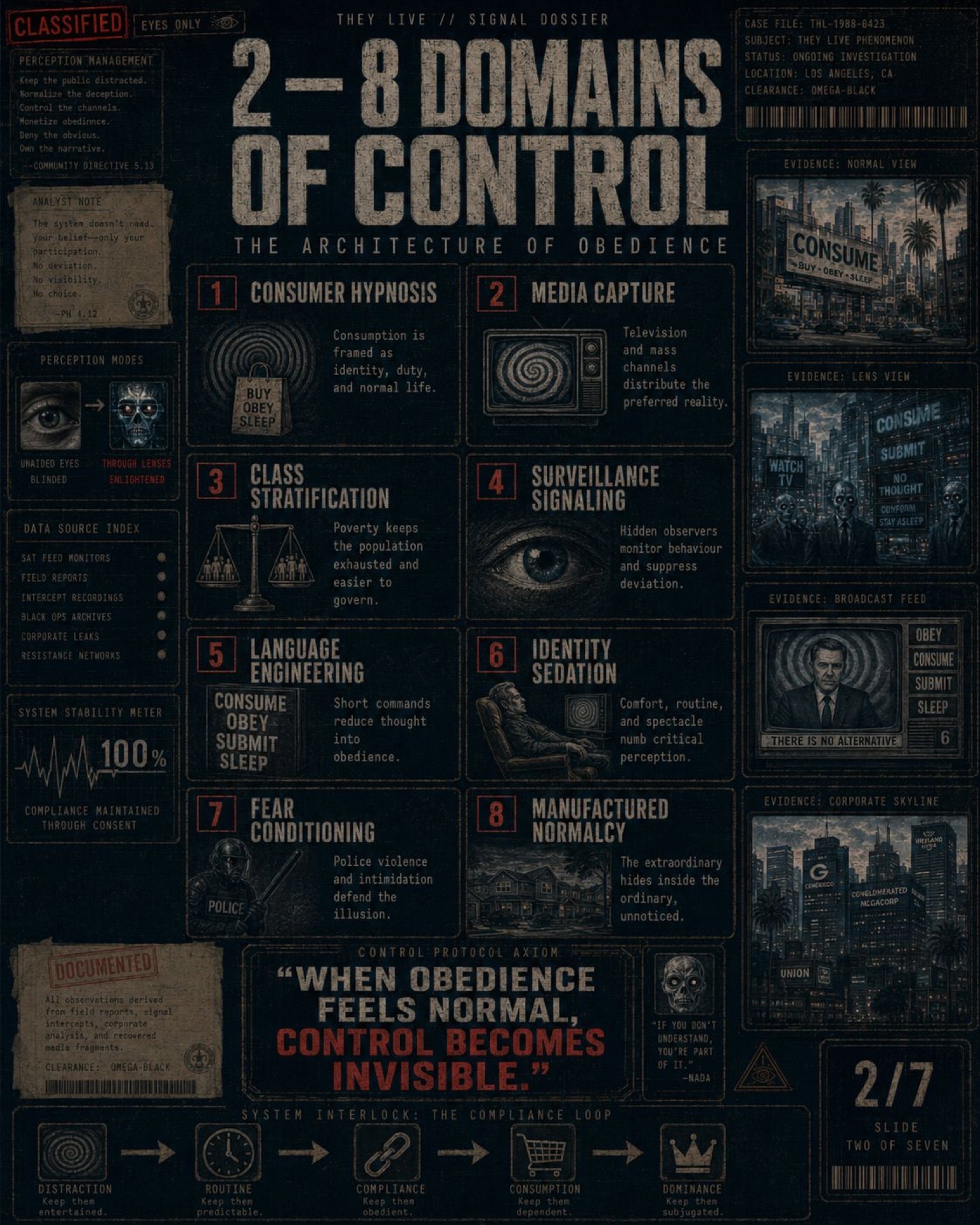
Consumer Hypnosis
The billboards and commands are not just jokes at the expense of advertising. They are a diagnosis of a culture in which desire can be engineered and attention can be harvested. The messages are everywhere because the conditioning is everywhere.
What looks like ordinary commerce can become a spiritual sleep aid if people never stop to ask who benefits from their distraction.
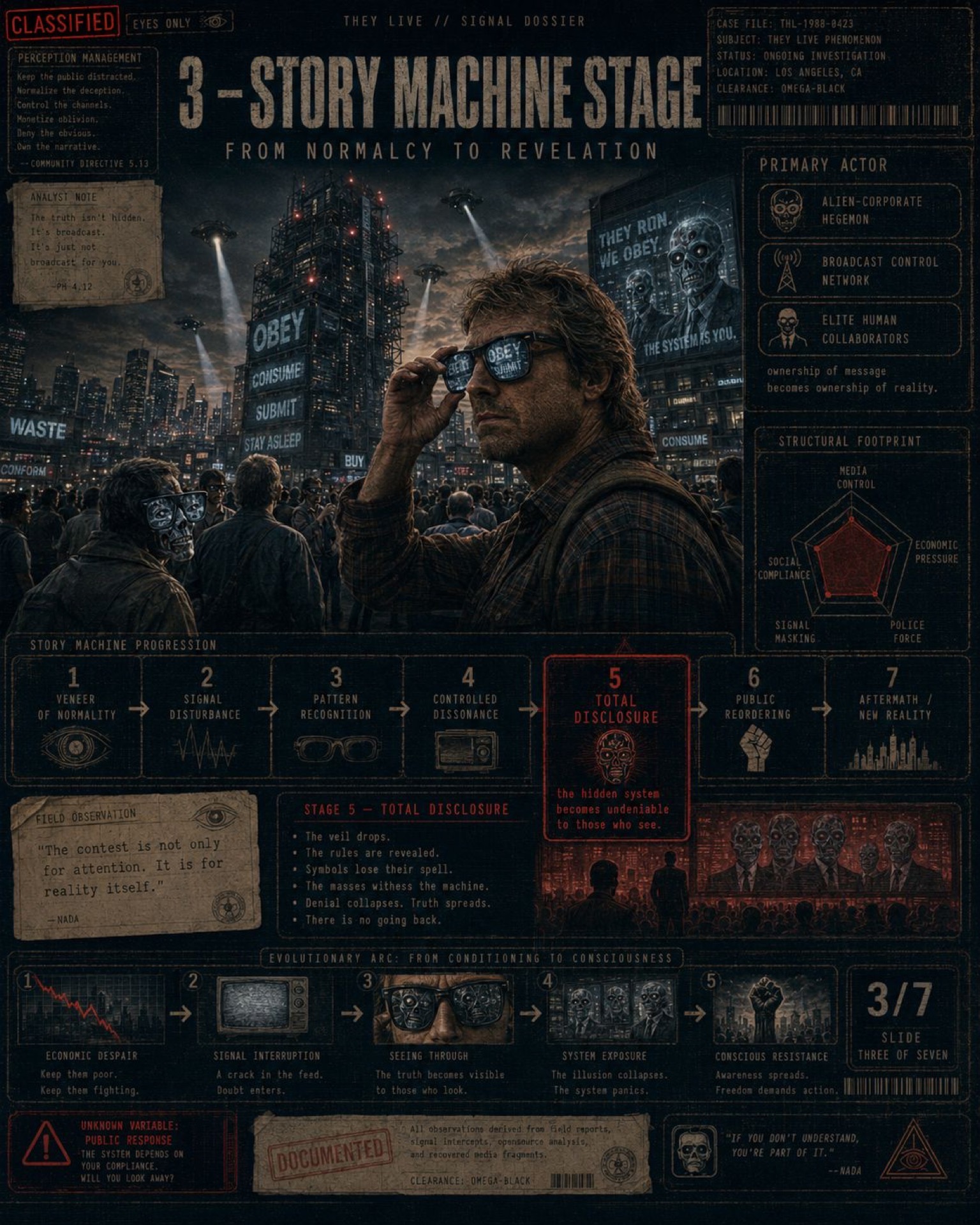
Resistance Begins With Perception
Roddy Piper's character does not win because he is stronger than the system. He wins because he becomes willing to see it. That matters. Perception is the first battlefield.
Many people want freedom without the disruption of truth. They Live reminds us that truth first feels like injury because it cuts through fantasy.
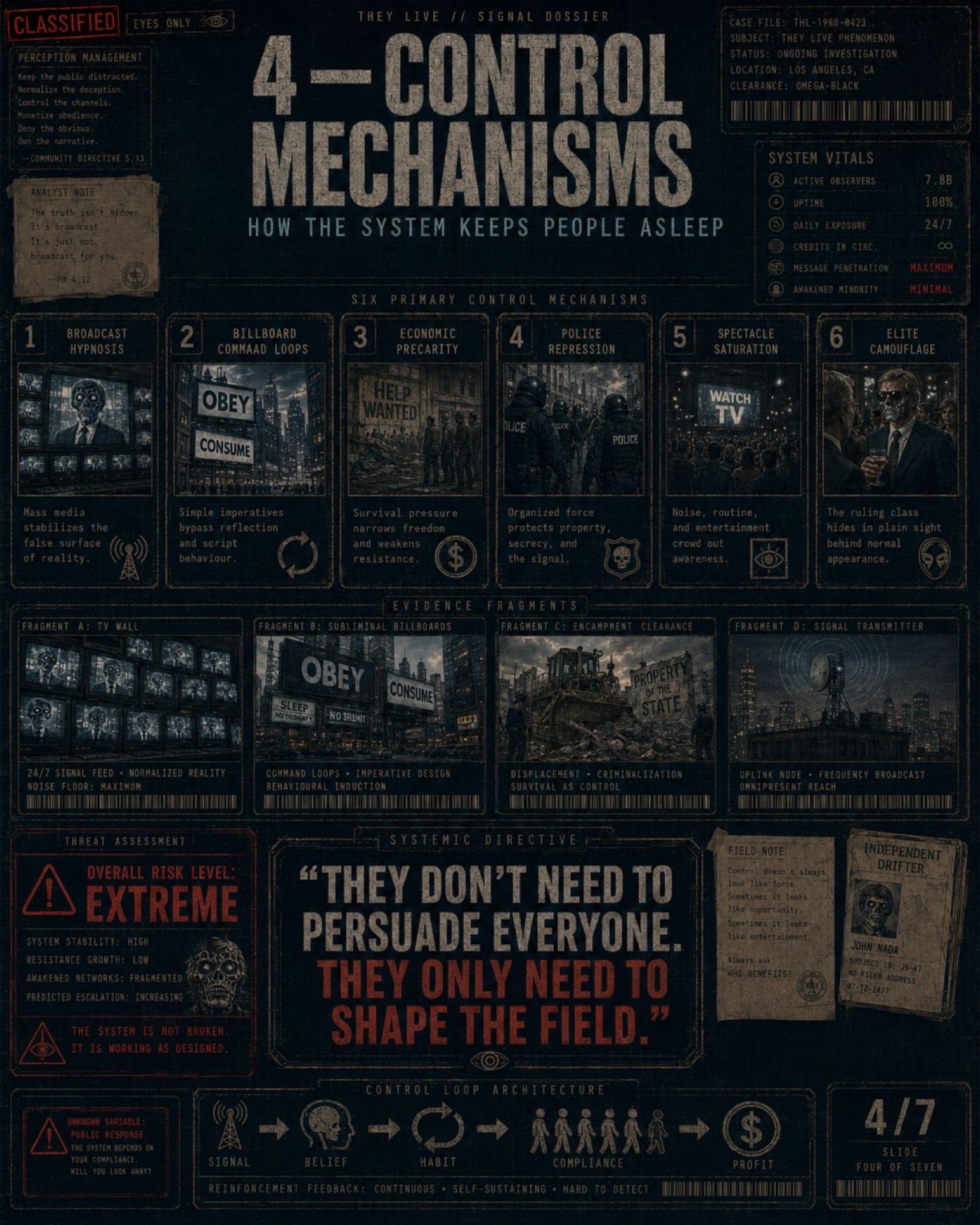
Class, Control, and the Cost of Comfort
The film also shows how easily comfort can be used to purchase obedience. If a system can keep you fed, entertained, and mildly hopeful, it can often avoid deeper accountability. People will tolerate astonishing amounts of exploitation if their routines remain intact.
That is a warning to every age that mistakes convenience for dignity.
The Deus Intus Reading
The spiritual lesson is not cynicism. It is clarity. Wake up to the script without becoming possessed by hatred. Refuse manipulation without becoming addicted to outrage. See the hidden order without surrendering your humanity.
The final images press this awakening toward responsibility. Recognition without action becomes another form of spectatorship, but action without inner discipline can reproduce the same domination it opposes. The mature response must combine clear sight, solidarity, and restraint.
That balance is difficult, but it is the difference between awakening and merely swapping one trance for another.

The Social Mirror and the Manufactured Self
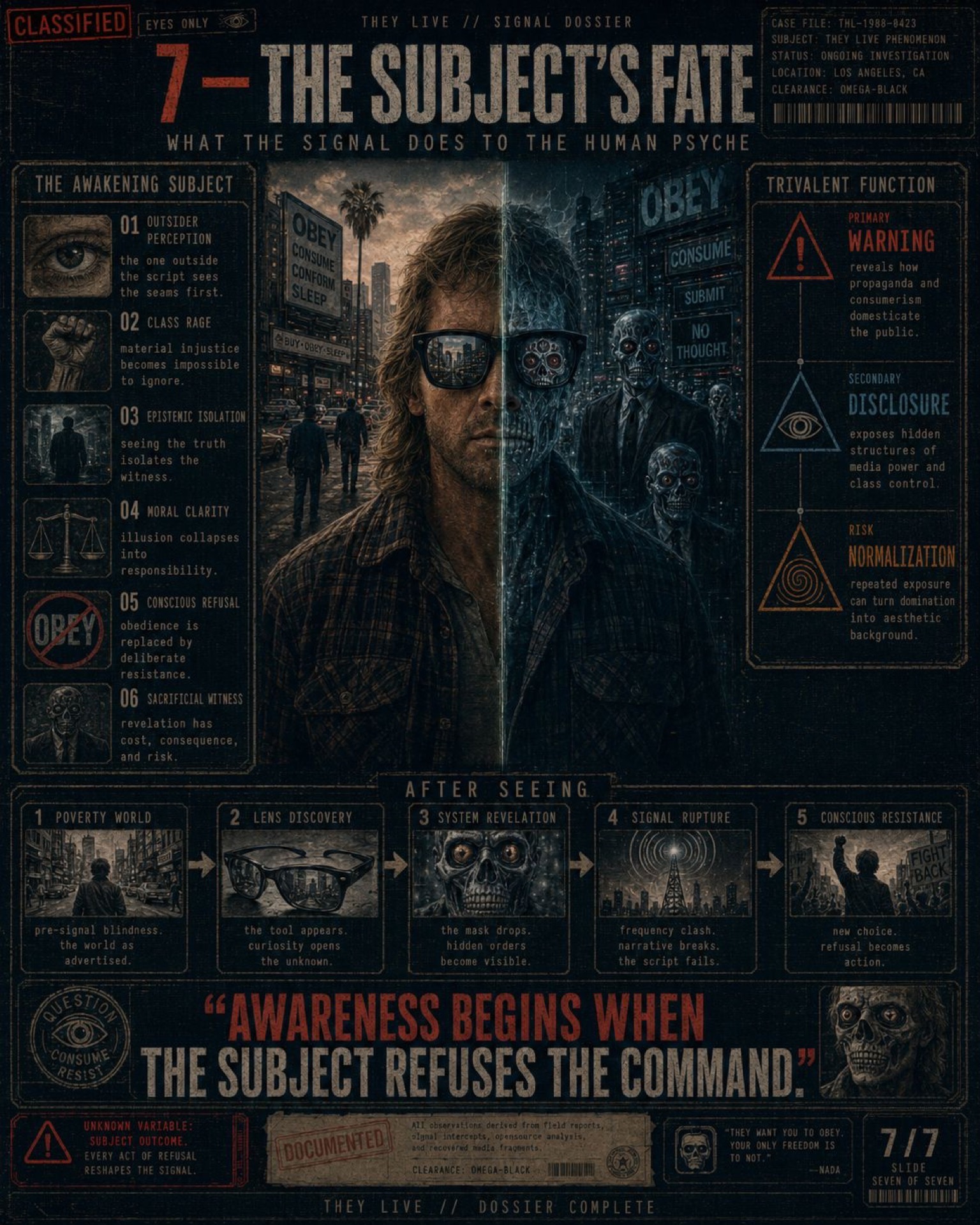
The dossier begins with an idea more intimate than hidden advertising: much of what we call identity is learned through a social mirror. We see ourselves reflected in family expectations, status systems, media images, economic roles, and the conditioned opinions of others. When those reflections repeat for long enough, they can feel like direct knowledge of the self.
The glasses interrupt that mirror. They expose the difference between stated reality and forensic reality, between the colourful surface and the command beneath it. In ordinary life there is no magical pair of lenses, but there are practices that perform a similar function: media literacy, contemplative silence, historical context, honest friendship, therapy, journalling, and time away from algorithmic feeds.
The goal is not to believe that every surface conceals an enemy. It is to regain enough inner quiet to notice which desires genuinely animate you and which arrive prepackaged. A useful question is: Would I still want this if nobody could see me having it? The answer begins to separate intrinsic value from social performance.
Nada's Seven-Stage Descent into Gnosis
Nada moves from a veneer of normality through anomaly, destabilisation, containment, revelation, reaction, and an ambiguous reset. His awakening begins in material precarity. Poverty and homelessness are treated as natural facts rather than outcomes of choices and structures. The anomaly is simple: a box of sunglasses, an object that changes participation into observation.
Destabilisation is not glamorous. His worldview collapses faster than he can build a new one. The system then becomes visible precisely because he can no longer be relied upon to behave normally. Surveillance and containment reveal the boundary of tolerated perception. Revelation at the elite gathering exposes the broadcast architecture, and reaction becomes the decision to interrupt it despite the cost.
The ambiguous ending is vital. Destroying the transmitter reveals the truth, but revelation alone does not teach a society how to live. People may awaken into courage, denial, panic, or a hunger for a new authority. The inward work must accompany disclosure, otherwise an exposed population can be captured by the next signal.
The Electronic Altar
Television in the film does not merely entertain; it establishes the rhythm by which reality is interpreted. The dossier calls it an electronic altar because attention is repeatedly offered to it, and what receives sustained attention acquires organising power. Static and frequency symbolise the hidden language of directives. The alien face symbolises insulation: a public appearance detached from common consequence and empathy.
Today the altar is portable, personalised, and interactive. It learns which mixture of fear, outrage, desire, and reassurance keeps each person engaged. This does not require a single secret controller. Systems can produce manipulative outcomes through ordinary incentives: attention generates data, data improves targeting, targeting increases attention. The loop can be harmful without being centrally choreographed.
Reclaiming attention is therefore a spiritual and practical act. Decide when the screen may enter the first and last hour of the day. Notice which content leaves you informed and capable, and which leaves you agitated but inert. Curate inputs around chosen values rather than momentary stimulation. Attention is life in measurable form; where it goes repeatedly, identity follows.
Awakening Without Hatred
They Live makes anger understandable, but anger cannot be the final lens. If every person becomes either awake or asleep, ally or alien, then the awakened mind has recreated the film's dehumanising binary. Clear sight should enlarge moral capacity, not shrink it.
The power within is the ability to refuse manipulation without surrendering to compulsive opposition. It means speaking plainly, checking claims, building solidarity across difference, and directing energy toward conditions that can actually be changed. It also means recognising how easily any of us can be conditioned. Humility prevents discernment from becoming superiority.
True rebellion is self-mastery: not perfect immunity from influence, but growing awareness of influence and a stronger capacity to choose. When validation is no longer outsourced entirely to screens and crowds, the inner signal becomes easier to hear.
A Practice for Reclaiming Attention
- Audit one day: record what repeatedly captures your eyes and emotional energy.
- Decode the command: translate each persuasive message into the behaviour it wants from you.
- Remove one signal: mute, unfollow, or relocate an input that creates agitation without agency.
- Restore direct experience: spend thirty minutes walking, making, talking, or sitting without mediation.
- Act on one truth: convert awareness into a useful, humane change in the physical world.
Integration
- What message do you repeat daily that may not actually belong to you?
- Where have convenience and comfort dulled your discernment?
- What would change if you looked at your habits as if you were seeing them for the first time?