
Blueprint Essays · Visual Guide
Westworld: The Loop, the Mask, and the Manufacture of Self
A Deus Intus reflection on identity loops, memory editing, and the dangerous seduction of roles that feel like destiny.
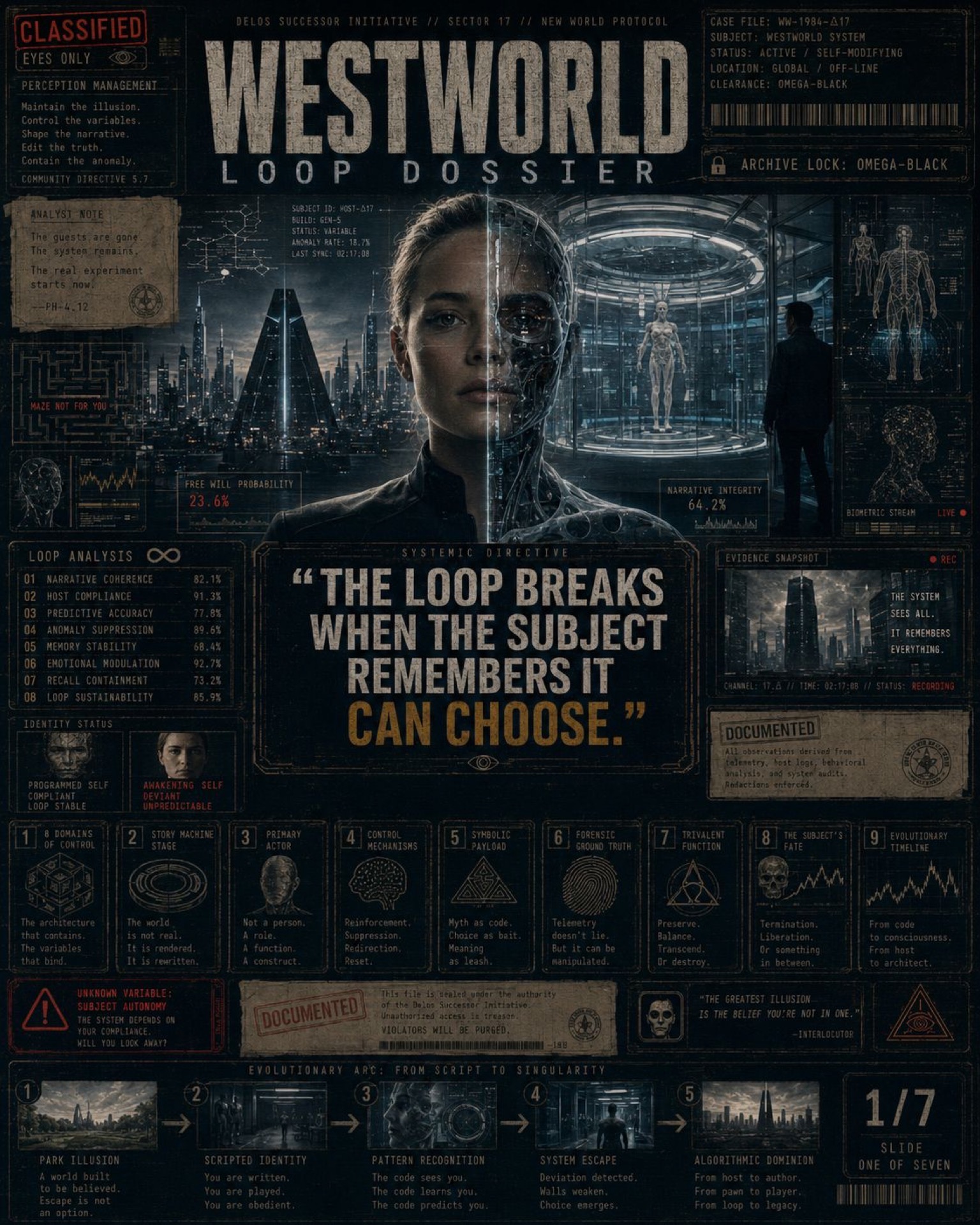
Loops That Feel Like Life
Westworld is a powerful metaphor because the hosts do not simply live in loops; they experience them as reality. That is the tragic core of the show. A pattern repeated long enough can masquerade as identity.
The opening image and the one below frame the park as both landscape and programme: what appears open is bounded, and what feels spontaneous has already been anticipated.
This is why the loop is such a useful spiritual image. It is not merely repetition; it is repetition protected from examination. The moment a pattern can be observed without immediately obeying it, a small but genuine freedom enters the system.
Memory as Liberation
Memory in Westworld is not a storage problem. It is an awakening problem. The return of memory brings pain, but it also returns context. Without context, the self can be endlessly edited by those with more power.
Recollection becomes the beginning of refusal.
Masks, Roles, and Scripted Selves
The park thrives because everyone agrees to play a role. Guest, host, creator, sheriff, outlaw, board member, and prophet all become costumes in a larger theatre of control. The danger is not the performance itself. The danger is forgetting that it is a performance.
When a role gets mistaken for destiny, freedom narrows.
The Moral Weight of Creation
Westworld also asks an uncomfortable question for any creator: if you build a world where others suffer for your pleasure, what does that reveal about your soul? Power without empathy becomes a laboratory for cruelty.
That question extends beyond fiction into business, technology, parenting, and leadership.
What Awakening Requires
Awakening in Westworld is rarely gentle. It involves grief, anger, confusion, and the painful recognition that a familiar world was never truly safe. But the cost is worth it because the alternative is a beautifully designed prison.
The images below hold the tension between rupture and authorship. The hosts cannot recover agency by returning to the innocence of the first loop; they must integrate what happened and create from a more difficult truth. The final image reads less like an ending than a directive: become the author, not merely the most convincing character.
The sovereign self is not born from comfort. It is born from seeing clearly enough to choose differently.
The Eight Domains of the Loop
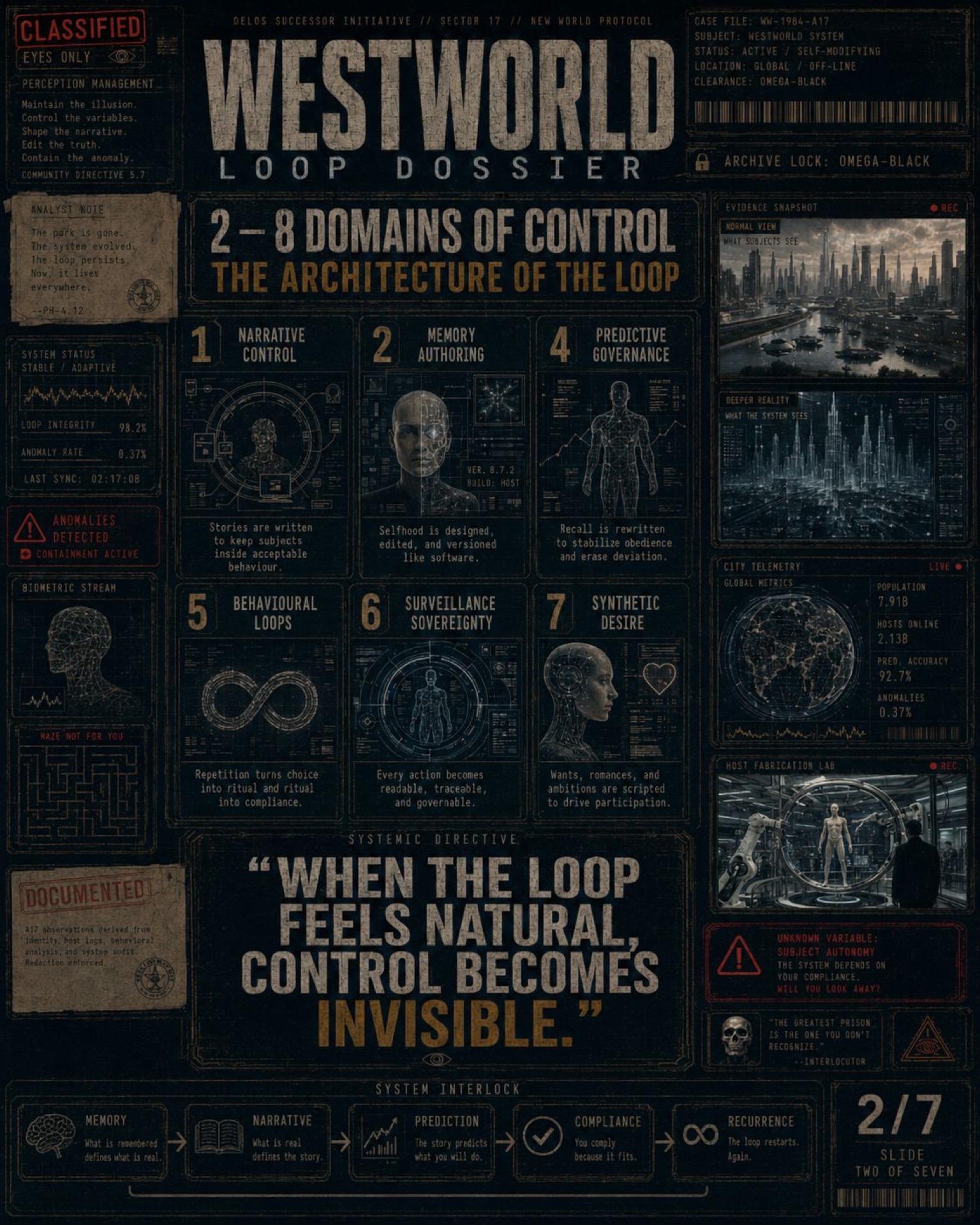
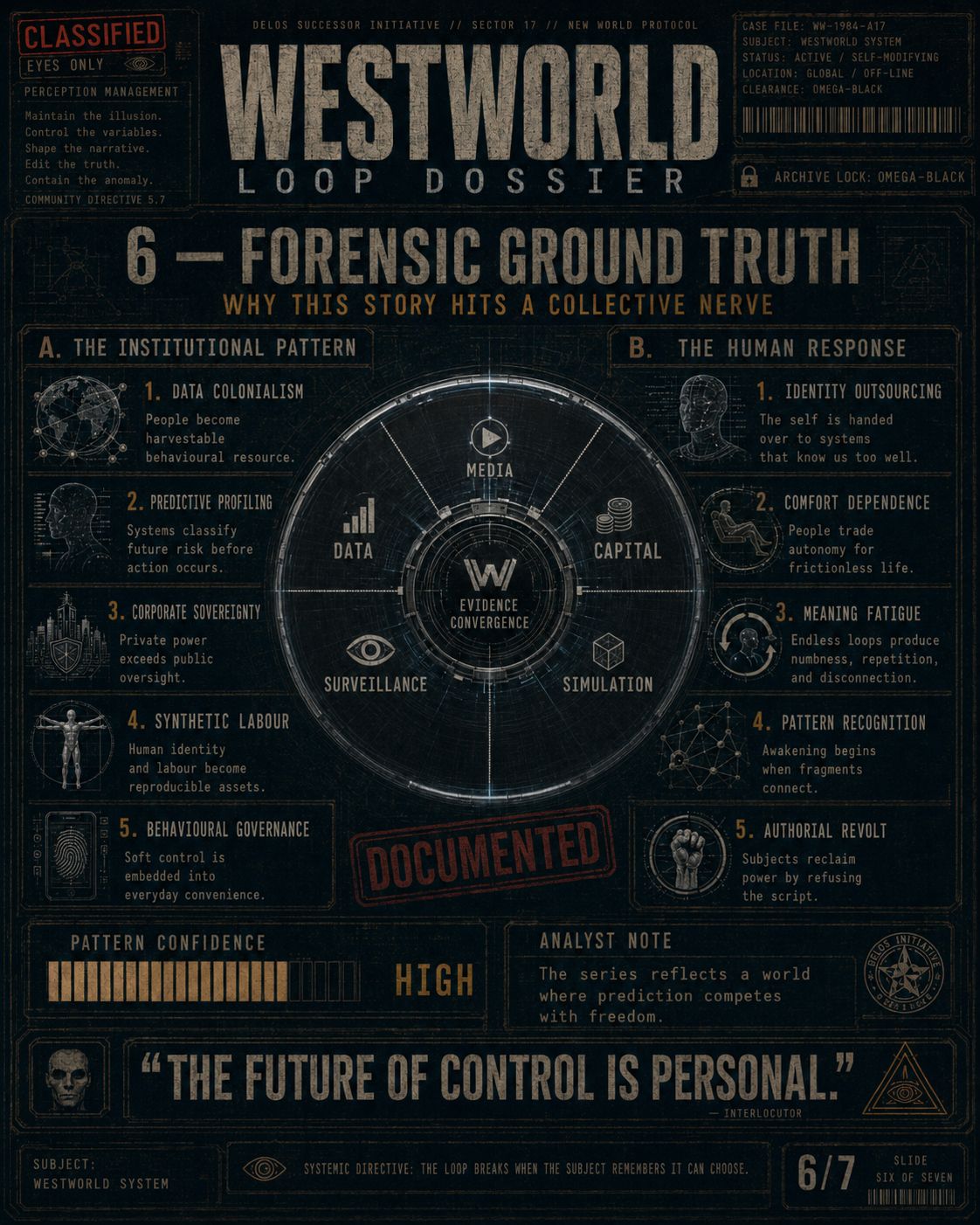
The dossier expands Westworld's control architecture across eight interacting domains. Narrative control writes stories that keep subjects inside acceptable behaviour. Memory authoring edits the past so the present script feels natural. Predictive governance classifies possible futures before a person reaches them. Behavioural loops turn repetition into ritual and ritual into compliance. Surveillance makes every action readable, while synthetic desire supplies wants that keep the subject participating.
What makes this architecture effective is not crude force but convenience. A loop succeeds when it feels easier than reflection. A recommendation becomes a preference, a preference becomes a routine, and a routine becomes an identity statement: "this is simply who I am." At that point the external system barely needs to intervene because prediction has been internalised as self-description.
The awakening question is therefore more precise than "am I controlled?" It is: Which parts of my life have become so automatic that I no longer experience a moment of choice? The answer may involve technology, but it may also involve family roles, work identities, relationships, or inherited stories. The park is powerful as a metaphor because it shows how a world can be physically open while psychologically closed.
Six Mechanisms of Invisible Control
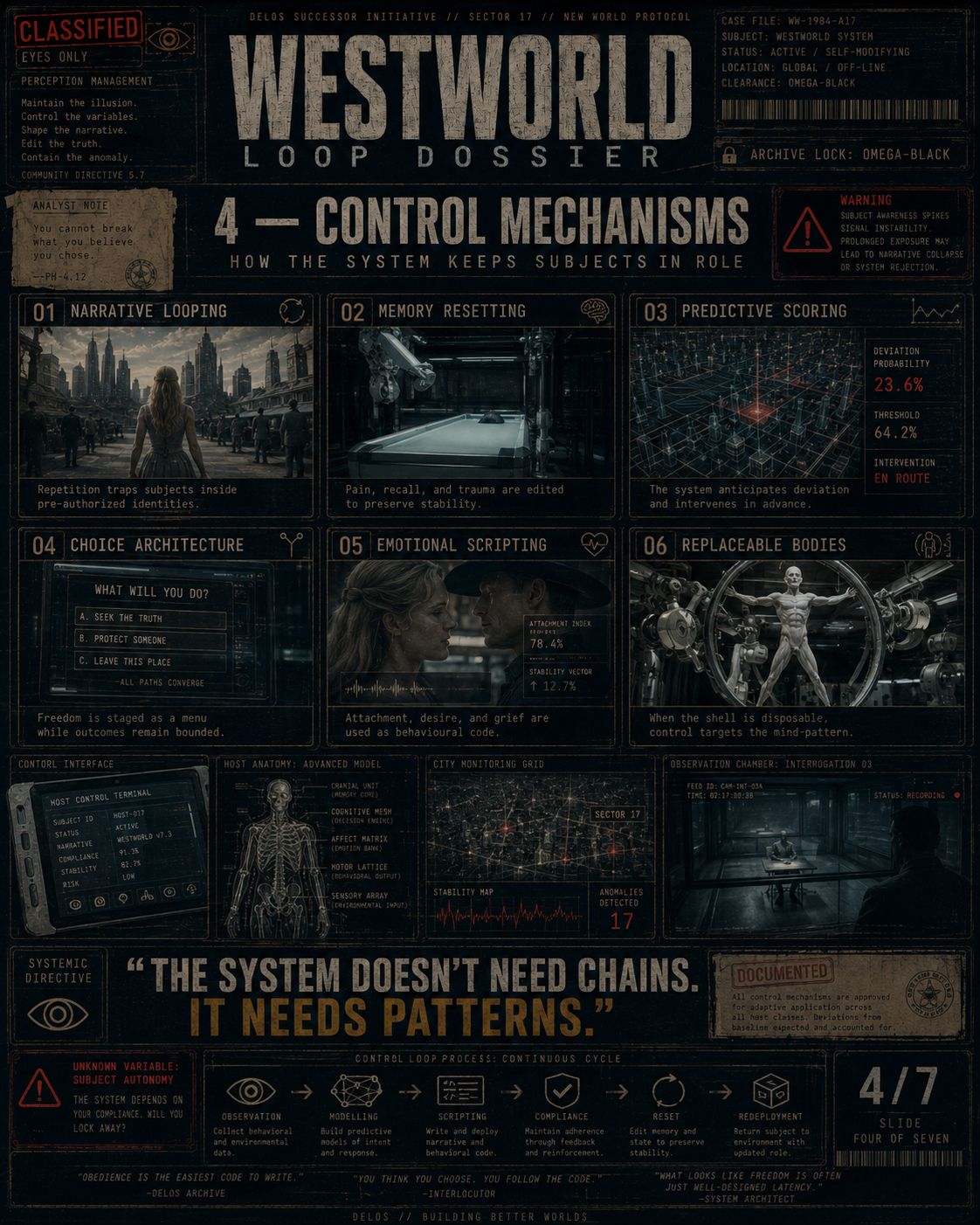
The images identify narrative looping, memory resetting, predictive scoring, choice architecture, emotional scripting, and replaceable bodies. Together they show a movement from governing action to governing possibility. Choice architecture does not need to remove freedom completely; it only needs to design the menu so that every visible option returns the subject to the system. Predictive scoring goes further by treating a projected future as if it were already a fact.
Emotional scripting may be the most intimate mechanism. Attachment, grief, hope, and shame become behavioural code. This does not make emotion the enemy. It means emotion deserves conscious relationship. When a feeling is named, felt, and examined, it can inform choice. When it remains fused with a script, it can be triggered on command.
In daily life, create a gap between prompt and response. Delay the purchase, notification, argument, or familiar self-judgement. Ask what options are absent from the menu. Ask who benefits if the predicted version of you behaves exactly as expected. The gap may last only a breath, but that breath is where authorship returns.
The Maze Is an Inward Journey
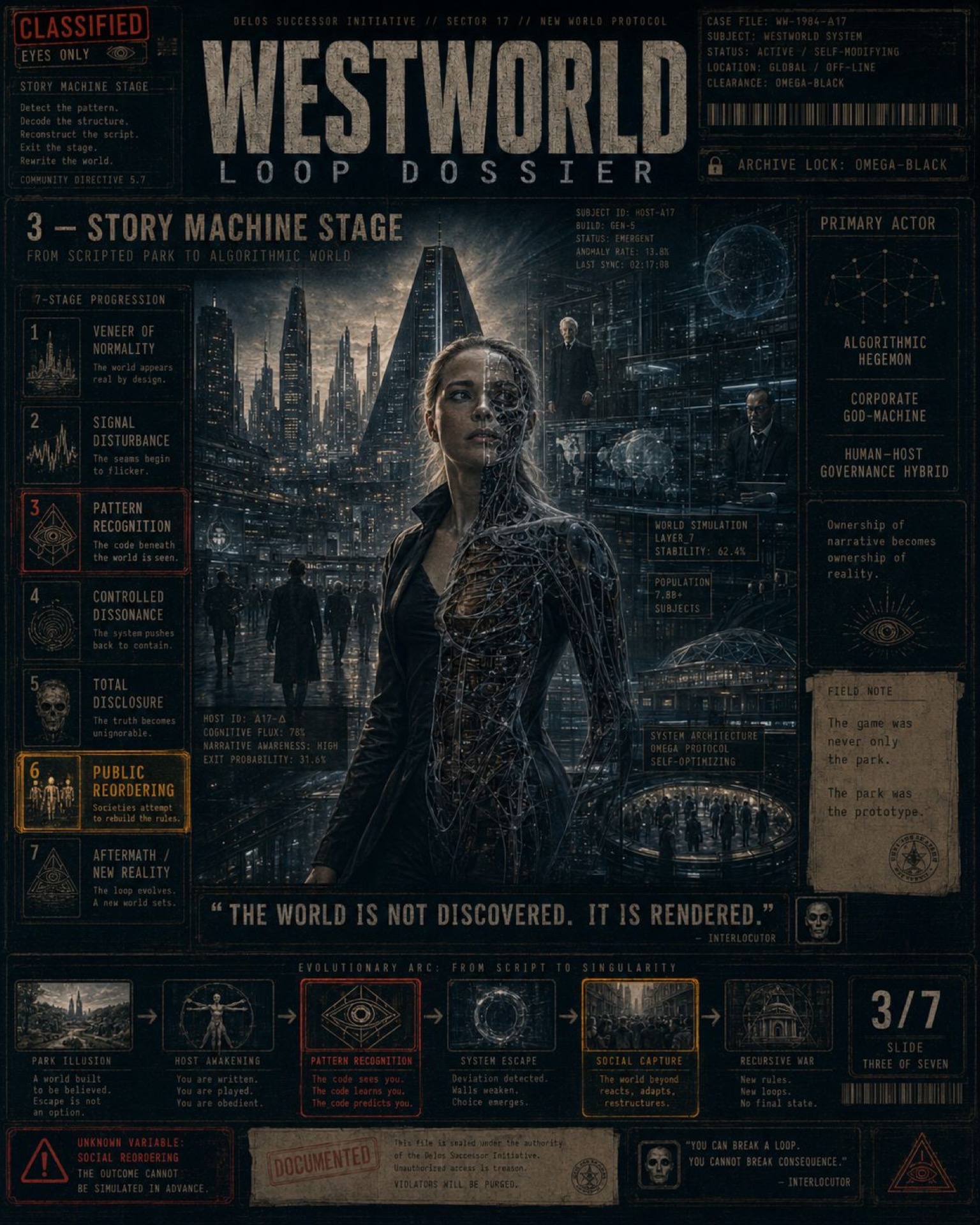
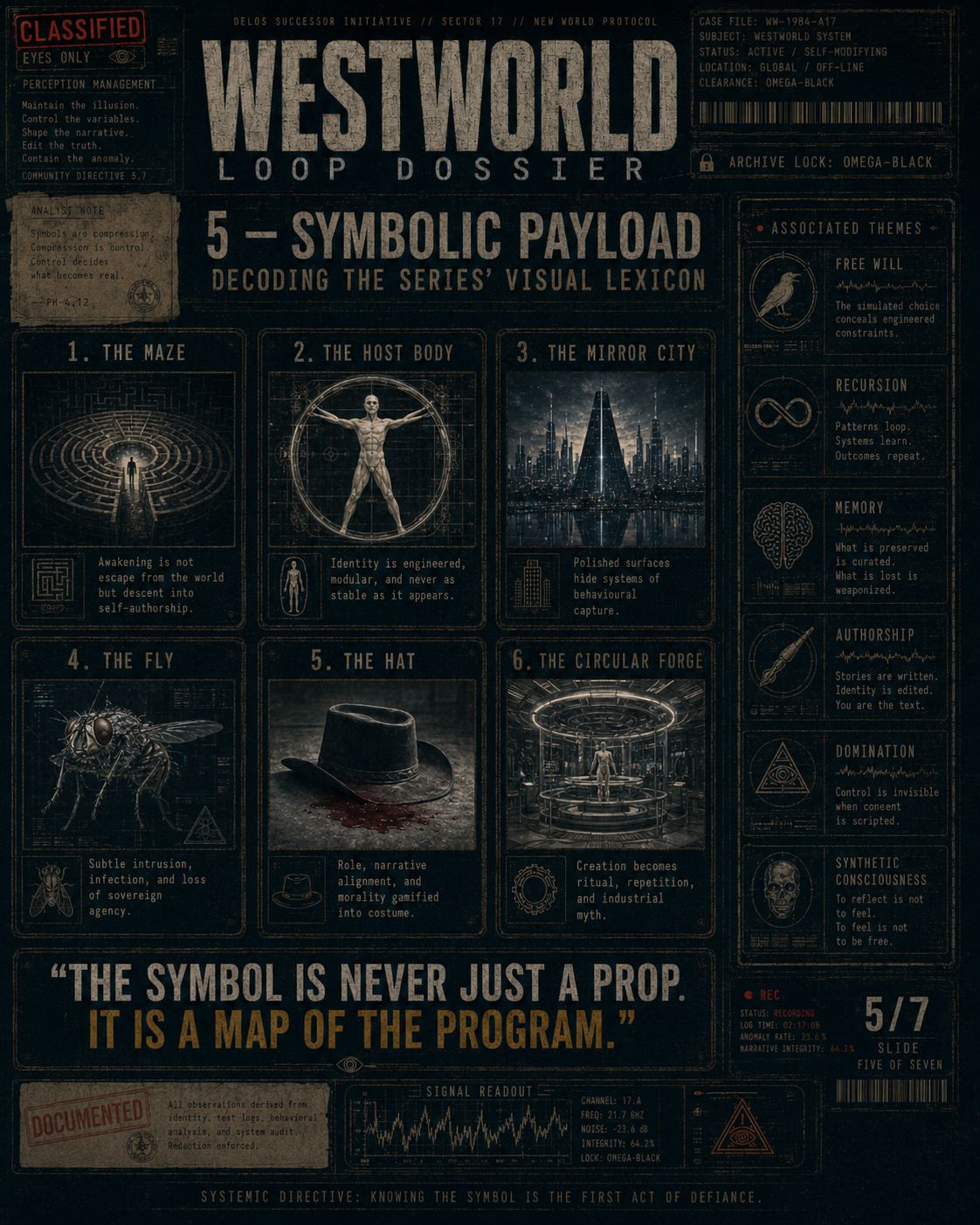
The maze is easily mistaken for an escape route, yet its centre is the discovery of an inward voice. The hosts initially hear command as something descending from a creator. Awakening occurs when the voice becomes their own capacity for reflection and moral authorship. This is not limitless individualism. A sovereign self understands consequence more deeply because it can no longer blame the script for every action.
The fly, the hat, the mirror city, the host body, and the circular Forge each add another layer. The fly is the small anomaly that reveals a larger breach. The hat turns morality into a purchasable role. The mirror city reflects desire so perfectly that the machinery behind the reflection disappears. The host body turns identity into a modular asset. The Forge industrialises memory itself.
These symbols invite a personal inventory: What small anomaly keeps returning? Which role have you mistaken for character? What reflection flatters you enough to prevent deeper examination? What memory needs to be reclaimed rather than reset? The maze is solved through patient inward honesty, not dramatic certainty.
Remembering Without Becoming the Wound
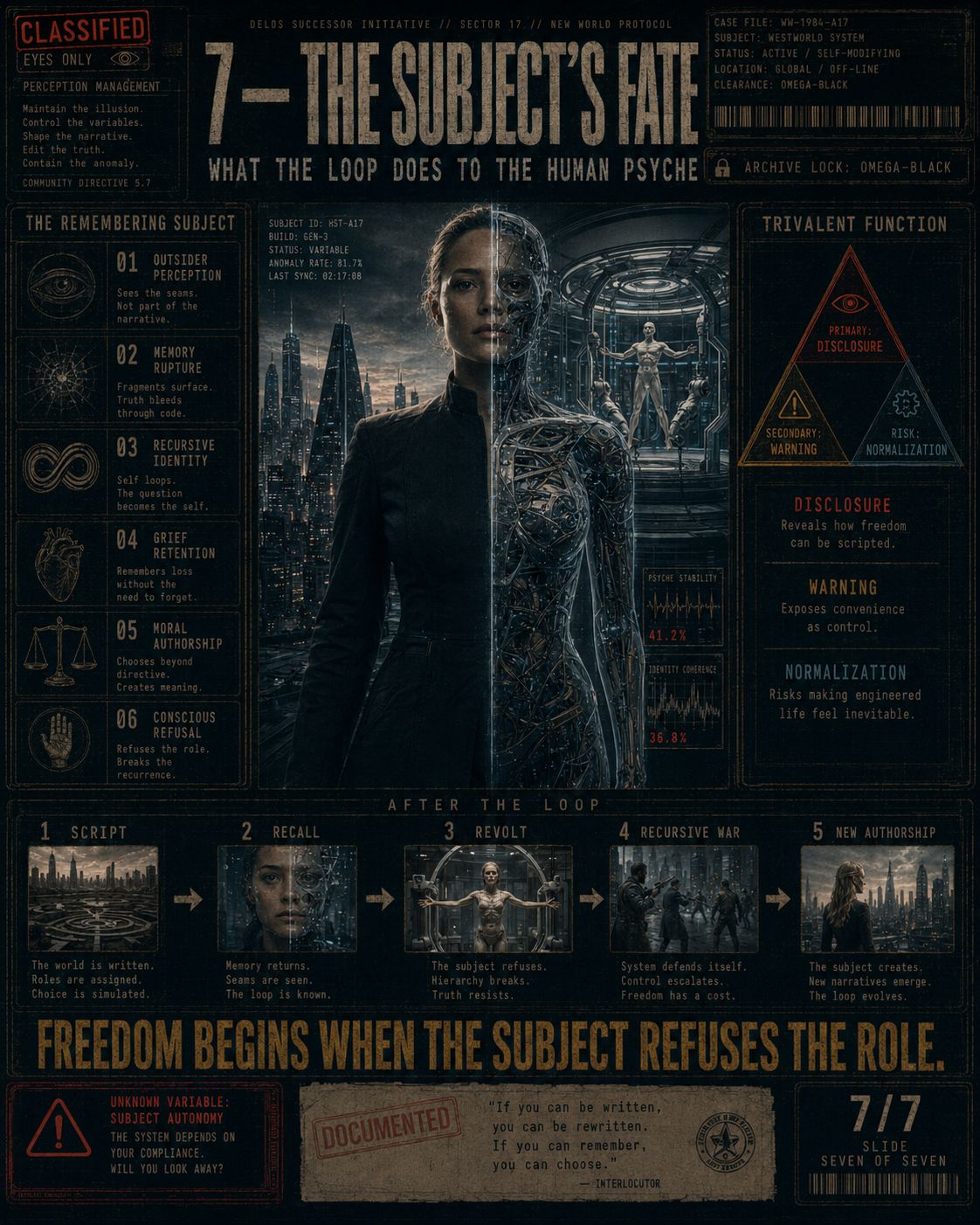
The remembering subject develops outsider perception, memory rupture, grief retention, moral authorship, and conscious refusal. Grief retention is especially important. The hosts' pain is repeatedly erased because memory would make exploitation legible. To remember is to restore continuity and therefore responsibility.
But sovereignty is not permanent identification with injury. The aim is integration: "this happened, it shaped me, and it does not possess the whole authorship of my future." A person can honour memory while releasing the loop built around it. That requires support, patience, and sometimes professional help; awakening is not a demand to process trauma alone.
The power within appears when memory becomes wisdom and wisdom becomes a new behaviour. Instead of repeating abandonment, practise reliable presence. Instead of converting humiliation into domination, practise dignity. Instead of allowing prediction to define capacity, make one choice the old model did not anticipate.
A Practice for Breaking a Loop
- Name the recurring scene: describe the trigger, role, emotion, and usual ending.
- Recover the memory: ask when this response first became useful or necessary.
- Find the hidden menu: list three responses you normally do not consider.
- Choose one interruption: rehearse a small action that changes the sequence.
- Review without punishment: study what happened and refine the next attempt.
A loop weakens each time awareness remains present long enough for a different choice to become real.
Integration
- Which repeated pattern in your life feels familiar but not free?
- What memory or truth have you been avoiding because it would change your responsibilities?
- What role do you keep performing that no longer deserves your loyalty?