
Blueprint Essays · Visual Guide
Utopia: The Fantasy of Perfect Order and the Price of Compliance
A Deus Intus reflection on engineered panic, false safety, and the danger of believing a system becomes good just because it becomes efficient.
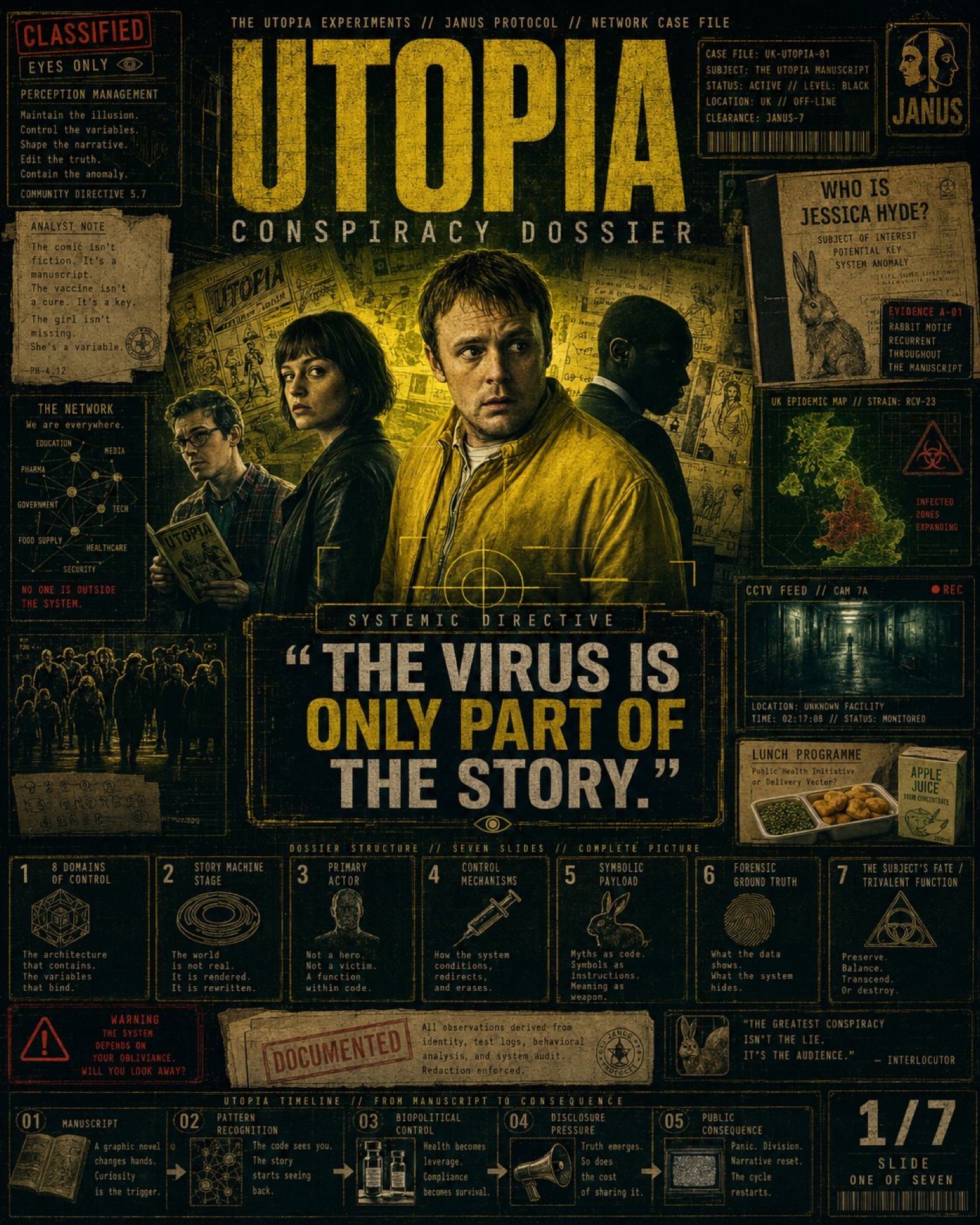
Perfection as a Trap
Utopia is unsettling because it dresses control in clean design. The system looks rational, even benevolent, until you notice that every promise of protection comes with a hidden demand for surrender.
It is the fantasy of a world with no friction, no uncertainty, and no messy human freedom. But a life without friction is not necessarily a life without harm. Sometimes it is just a life where harm has been tidied up.
Fear Needs a Costume
The story reveals how fear can be repackaged as expertise. When people feel unsafe, they become easier to guide. When a threat seems scientific, people hesitate to question it. When authority appears calm, they assume it is honest.
The images surrounding this section place institutional certainty beside human vulnerability: one speaks in the language of necessity while the other must absorb the consequences.
The distinction is not between expertise and ignorance. It is between expertise that remains accountable and expertise that treats ordinary people as raw material. Utopia asks us to preserve that distinction precisely when fear makes nuance feel inconvenient.
The Body Becomes the Battlefield
Utopia keeps returning to the body because every control system eventually lands there. What gets eaten, touched, injected, hidden, monitored, or isolated becomes political very quickly. The body is the place where abstract policy becomes lived experience.
That is why the visual sequence carries such weight. It refuses to let the viewer remain in theory.
Signal, Noise, and Narrative Capture
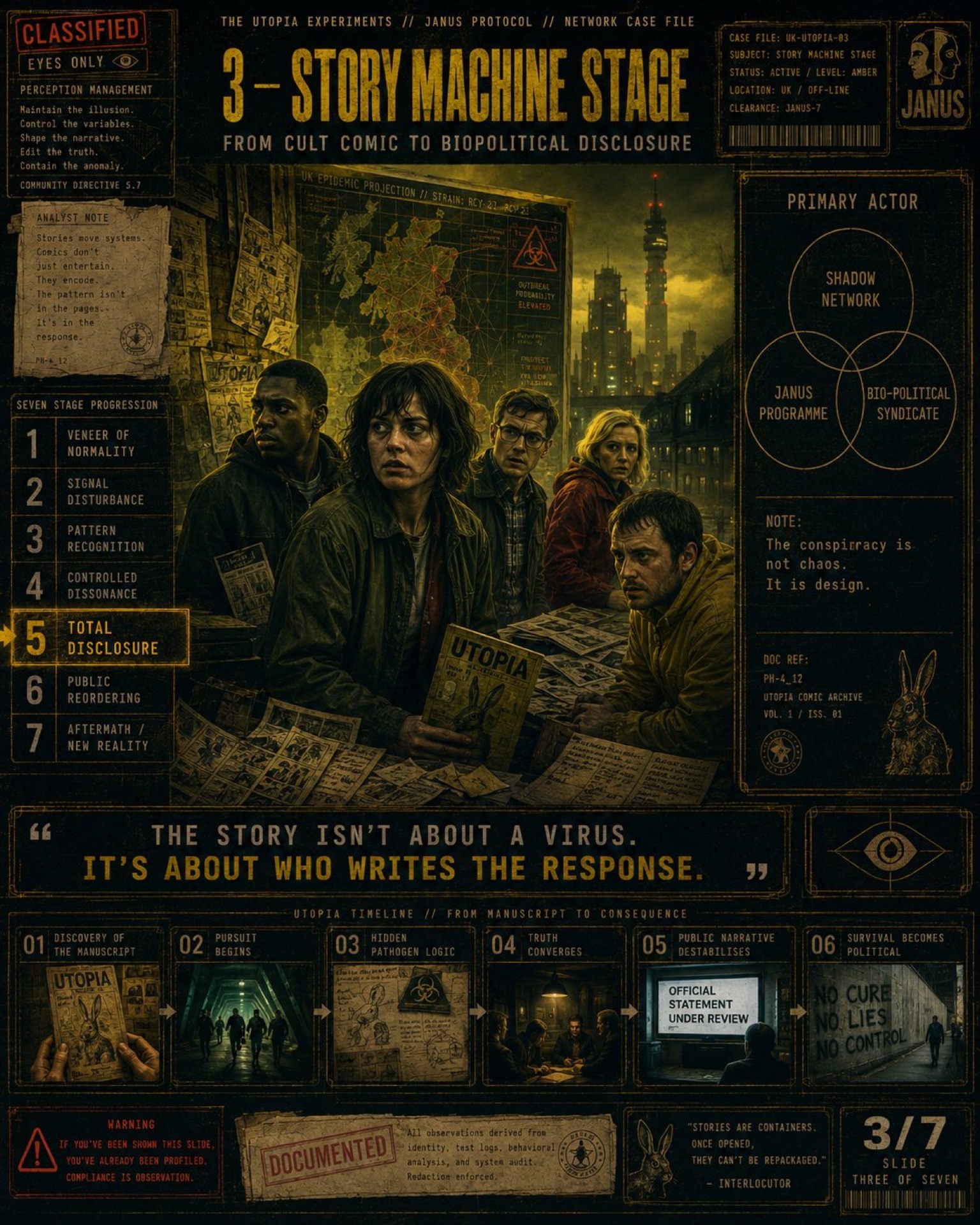
The series also shows how quickly information can become a weapon. Not everything said loudly is true. Not everything repeated is credible. In a managed environment, the story of reality is often more important than reality itself.
Utopia asks what happens when narrative replaces trust and when collective confusion becomes an operating principle. The later images move from exposure toward choice. They suggest that seeing the machinery is only the first task; the harder task is deciding what kind of person to become once innocence is no longer available.
The Deus Intus Reading
The deeper lesson is not paranoia; it is discernment. Healthy systems do not require blind obedience. Healthy leadership does not demand the suppression of questions. Healthy people do not confuse certainty with wisdom.
Utopia becomes a mirror for any culture that mistakes performance for integrity.
Eight Domains, One Architecture
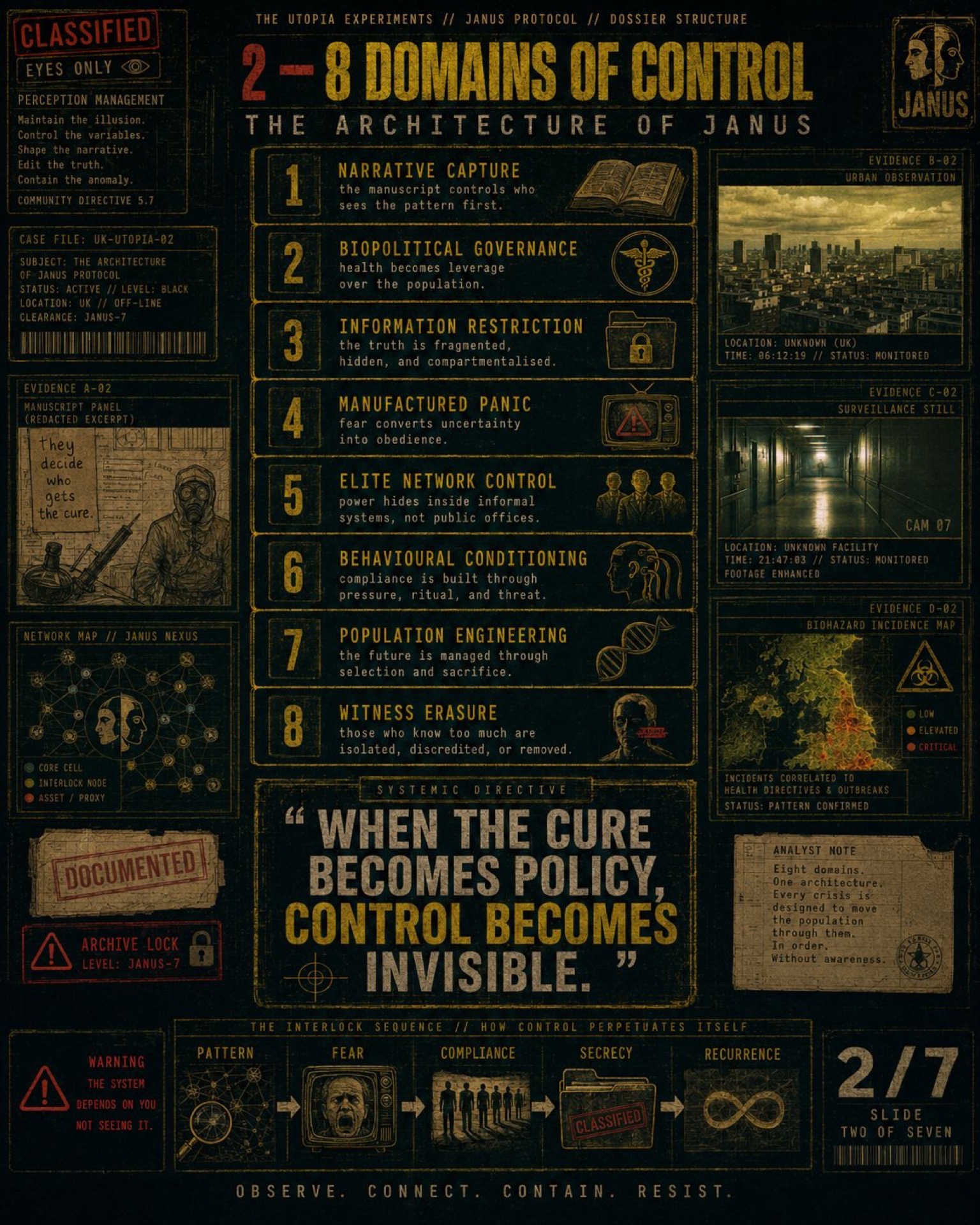
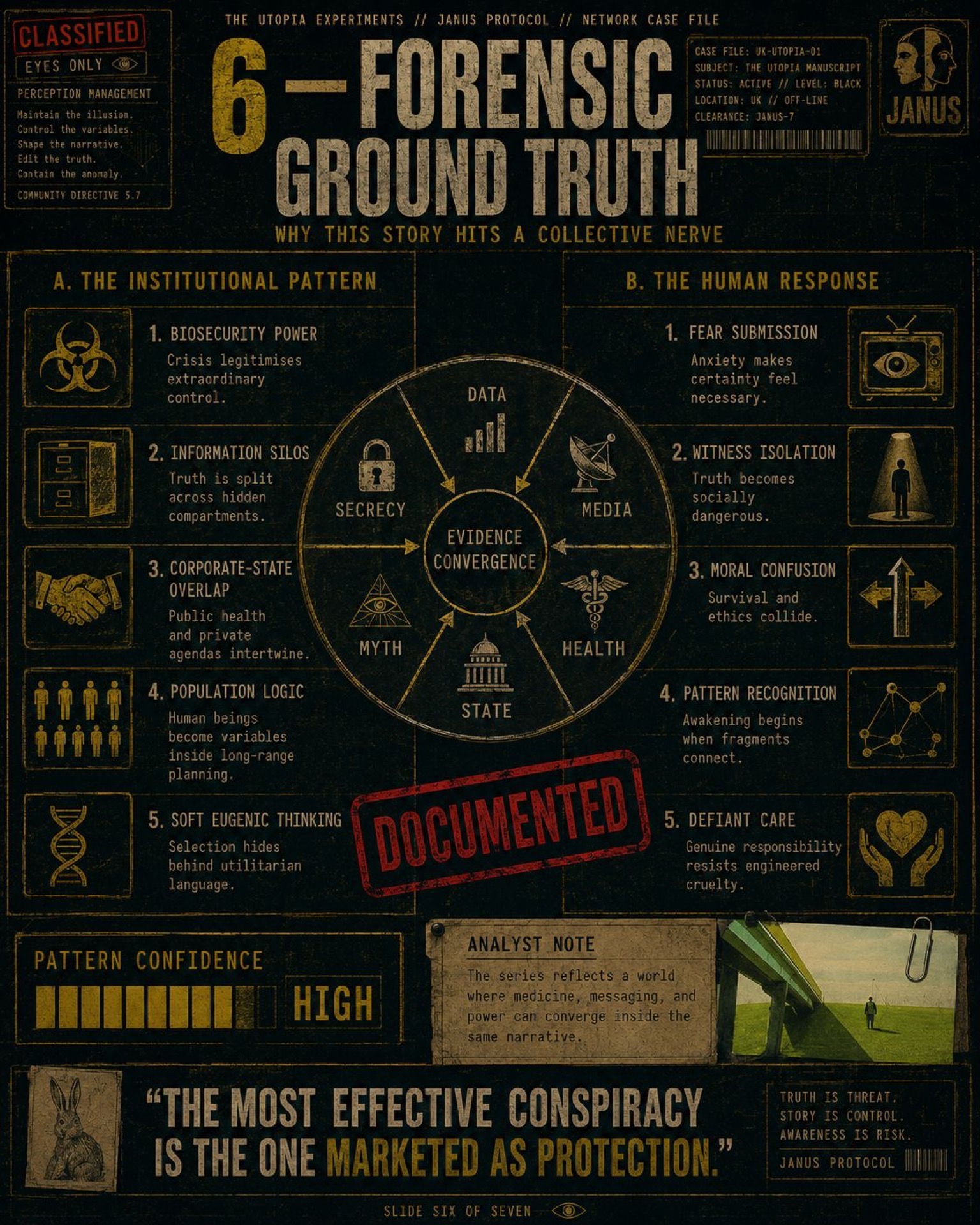
The second dossier image names eight domains of control: narrative capture, biopolitical governance, information restriction, manufactured panic, elite network control, behavioural conditioning, population engineering, and witness erasure. Their power lies in combination. A single institution rarely needs to command everything when several systems can reinforce one another through incentives, secrecy, repetition, and fear.
Narrative capture determines who is allowed to describe the pattern. Information restriction fragments the evidence so that no observer sees the whole. Manufactured panic narrows the time available for reflection. Behavioural conditioning then converts temporary emergency responses into habits, while institutional compartmentalisation ensures that each participant can claim to see only one harmless piece.
This model is useful beyond the plot if it is held with discipline. It should not become a claim that every crisis is fabricated or every institution is malicious. Instead, it offers better questions: Who defines the problem? What evidence can be independently checked? Which incentives shape the proposed response? What safeguards protect dissent, bodily autonomy, and revision when new information appears? Discernment grows through better questions, not through automatic disbelief.
The Control Feedback Loop
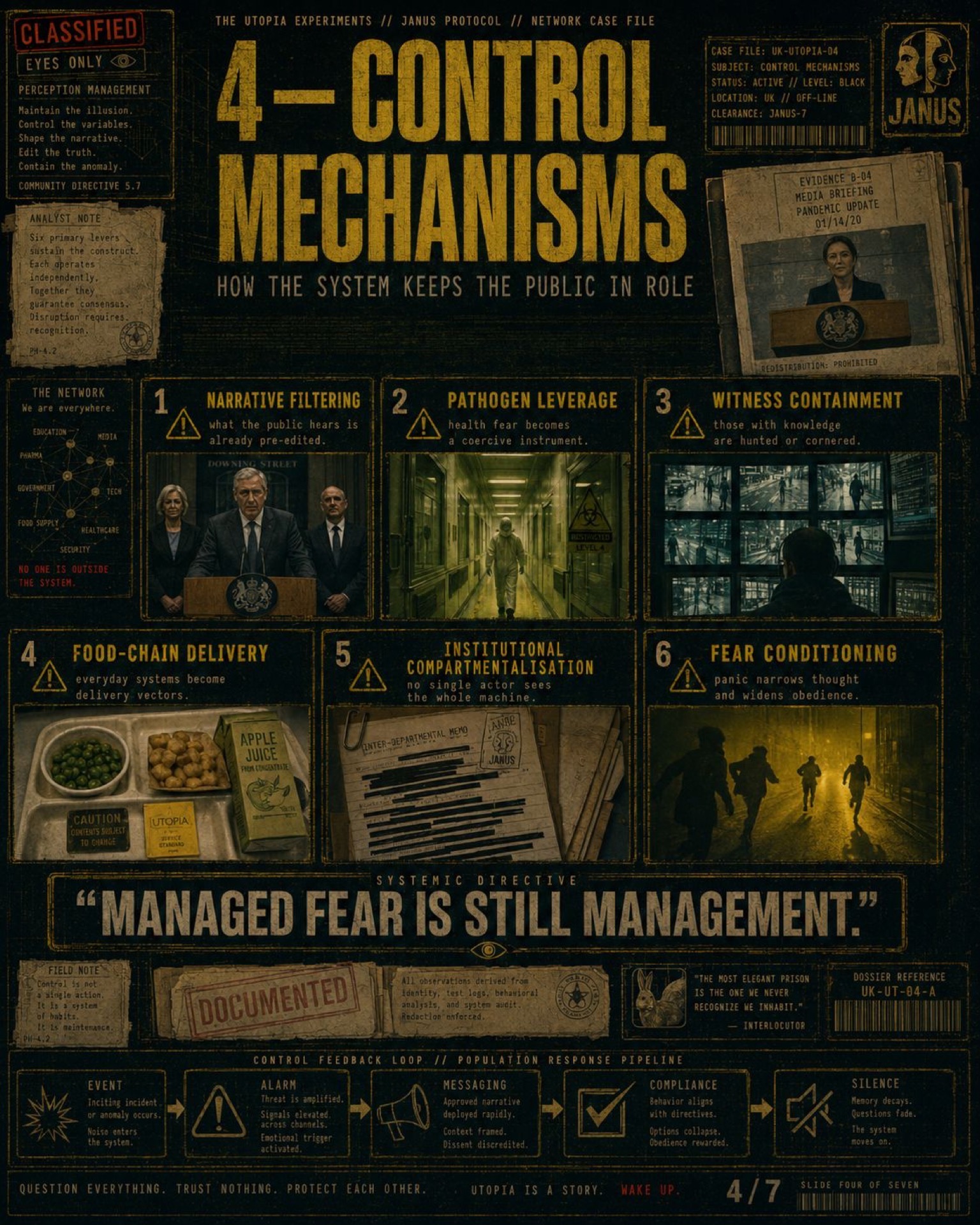
The fourth image reduces the mechanism to a repeating chain: event, alarm, messaging, compliance, silence. An incident creates uncertainty. Signals are amplified across channels until urgency dominates attention. An approved narrative arrives quickly, while context and dissent become socially expensive. Behaviour aligns with directives, memory fades, and the system becomes ready for the next recurrence.
The awakening intervention can occur at every stage. During the event, regulate the nervous system before making meaning. During alarm, limit repetition and seek primary evidence. During messaging, compare language across sources and notice emotional framing. During compliance, ask whether the action is proportionate, transparent, and reversible. During silence, preserve records and make room for honest review. This is not obstruction; it is how a healthy public prevents emergency from hardening into invisible control.
Symbols That Teach the Pattern
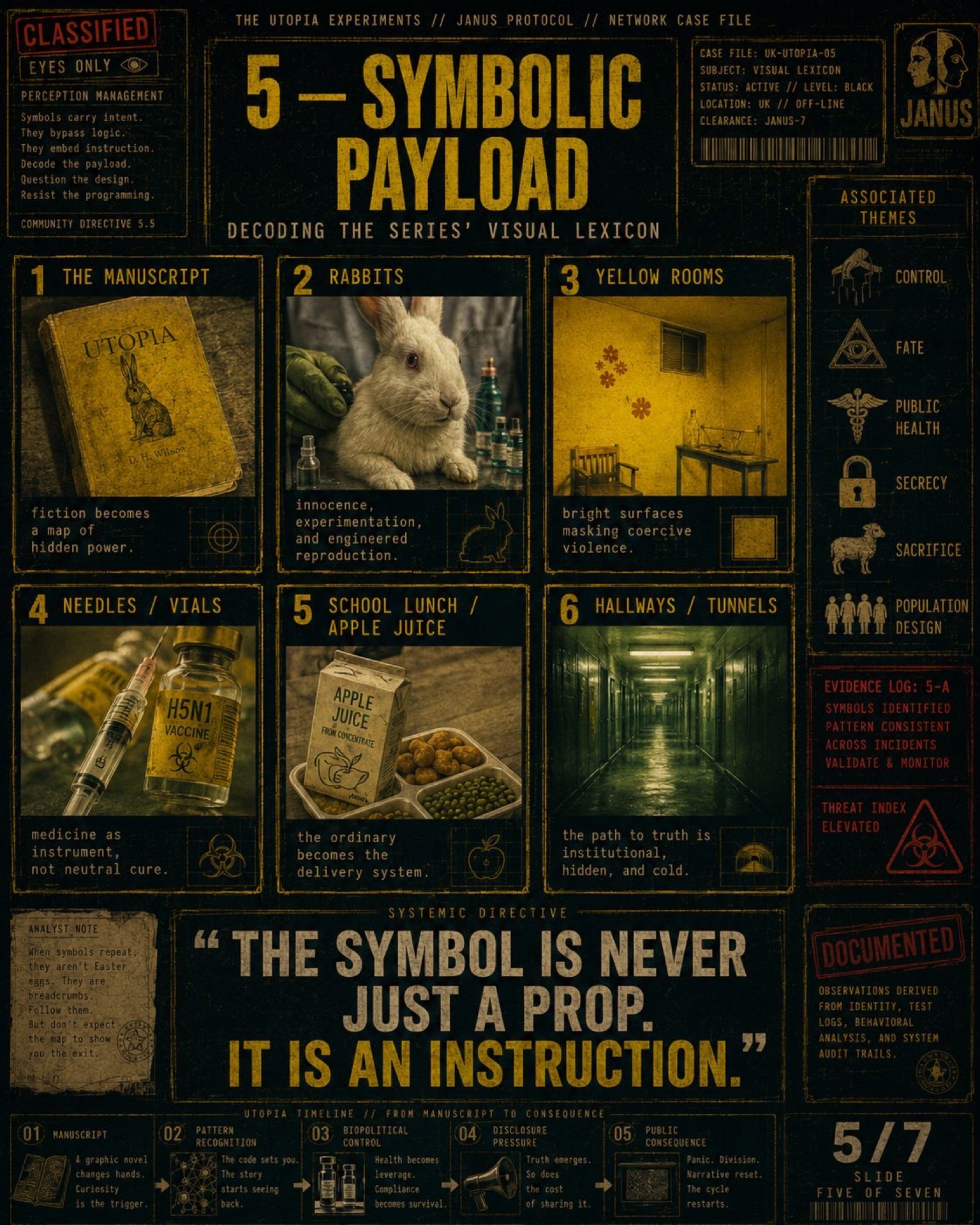
The manuscript represents fiction as a map of hidden power. Rabbits carry the tension between innocence, experimentation, and engineered reproduction. Yellow rooms use brightness to conceal coercion. Needles and vials symbolise medicine becoming an instrument of policy rather than a relationship of care. School lunches and apple juice show how ordinary delivery systems can carry decisions made elsewhere. Corridors and tunnels embody institutional truth: hidden, cold, and difficult to navigate.
Symbols matter because the nervous system often recognises a pattern before language catches up. Yet a symbol is a prompt for inquiry, not proof. Awakening requires both intuition and verification. Intuition says, "pay attention"; evidence determines what the attention means. Keeping those functions together protects us from both naivety and projection.
From Hypervigilance to Pattern Consciousness
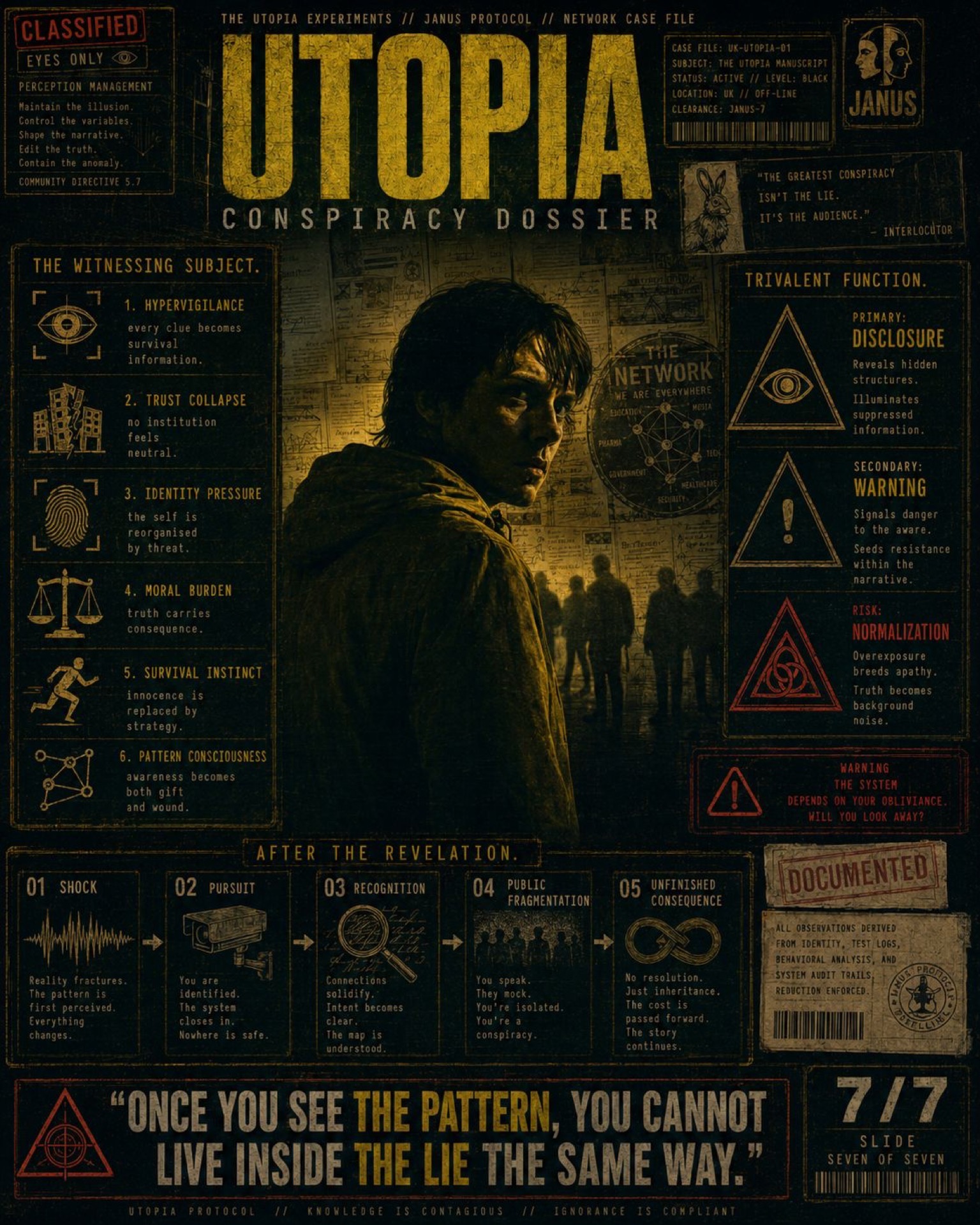
The final image names the cost of becoming a witnessing subject: hypervigilance, trust collapse, identity pressure, moral burden, survival instinct, and pattern consciousness. These are not all signs of freedom. Hypervigilance can make every clue feel like danger; trust collapse can isolate the person who most needs community. Awakening that never reaches nervous-system safety may reproduce the very fear architecture it seeks to escape.
The power within is the ability to hold awareness without being consumed by it. Build calibrated trust rather than blind trust or total distrust. Let uncertainty remain uncertainty. Test interpretations with people who can disagree respectfully. Practise defiant care: protect dignity, support those carrying consequences, and refuse to turn human beings into variables. The series' most constructive counterweight to engineered cruelty is not suspicion but responsible relationship.
A Practice for Clear Discernment
- Pause the alarm: take five slow breaths before sharing emotionally charged information.
- Map the claim: write the source, evidence, incentive, uncertainty, and likely consequence.
- Check the body: notice whether urgency is improving perception or merely accelerating reaction.
- Seek a good challenge: ask a trustworthy person to show where your interpretation may be incomplete.
- Choose defiant care: take an action that protects truth and human dignity at the same time.
Integration
- Where have you accepted order without checking the cost?
- What information source do you trust without ever slowing down to question it?
- Which part of your life would become healthier if you made space for honest uncertainty?